Free Shipping on Orders Over $50

1.1 Origin and Development of Vantablack Paint
Contenus
afficher
The Vantablack paint is a recent innovation that has garnered a lot of attention due to its ability to absorb up to 99.965% of visible light. Developed by the British company Surrey NanoSystems in 2014, this paint was initially designed for applications in aerospace and cutting-edge technology. Researchers created Vantablack using vertically aligned carbon nanotubes, allowing light to be captured efficiently without being reflected.
The origin of its name comes from the acronym VANTA, which stands for Vertically Aligned Nanotube Arrays. Its development has revolutionized not only the aerospace industry but also opened new perspectives in the field of art and design. The process of creating Vantablack involves a complex and highly controlled technology, making its production difficult and costly, but extremely interesting for multiple application areas.

Select options
This product has multiple variants. The options may be chosen on the product page
Music Ferrofluid
$218.99
Ferrofluid Decoration
$402.99
Select options
This product has multiple variants. The options may be chosen on the product page
Ferrofluid Lamp
$137.991.2 Unique Characteristics
The characteristics of the Vantablack paint are absolutely fascinating. Besides its incredible light absorption capacity, it also has other unique properties. Its structure composed of carbon nanotubes gives it a surface that appears almost two-dimensional, making any underlying features and details disappear. Thus, objects covered in Vantablack seem to transform into silhouettes without depth or defined shape.
Furthermore, due to its composition, Vantablack paint is also very durable and can withstand extremely high temperatures. Its surface can also be made hydrophobic, allowing it to repel water and liquids. These unique properties make Vantablack paint a preferred choice for applications requiring exceptional durability and performance.
1.3 Common Applications
The applications of Vantablack paint are varied and transcend traditional sectors. In aerospace, it is used to reduce glare and enhance the performance of optical systems and space cameras. In watchmaking, it allows for the creation of watch dials with unparalleled visual depth. In art, artists like Anish Kapoor have exploited its aesthetic potential to create works that play on the viewer’s visual and spatial perception.
In architecture and design, Vantablack paint offers the possibility of creating optical illusions and immersive experiences by concealing structural elements and altering the appearance of spaces. Despite its rarity and cost, the demand for this ultra-black paint continues to grow, pushing the boundaries of innovation and offering unprecedented applications in various creative fields.
2. The Process of Creating Vantablack Paint
2.1 Necessary Materials
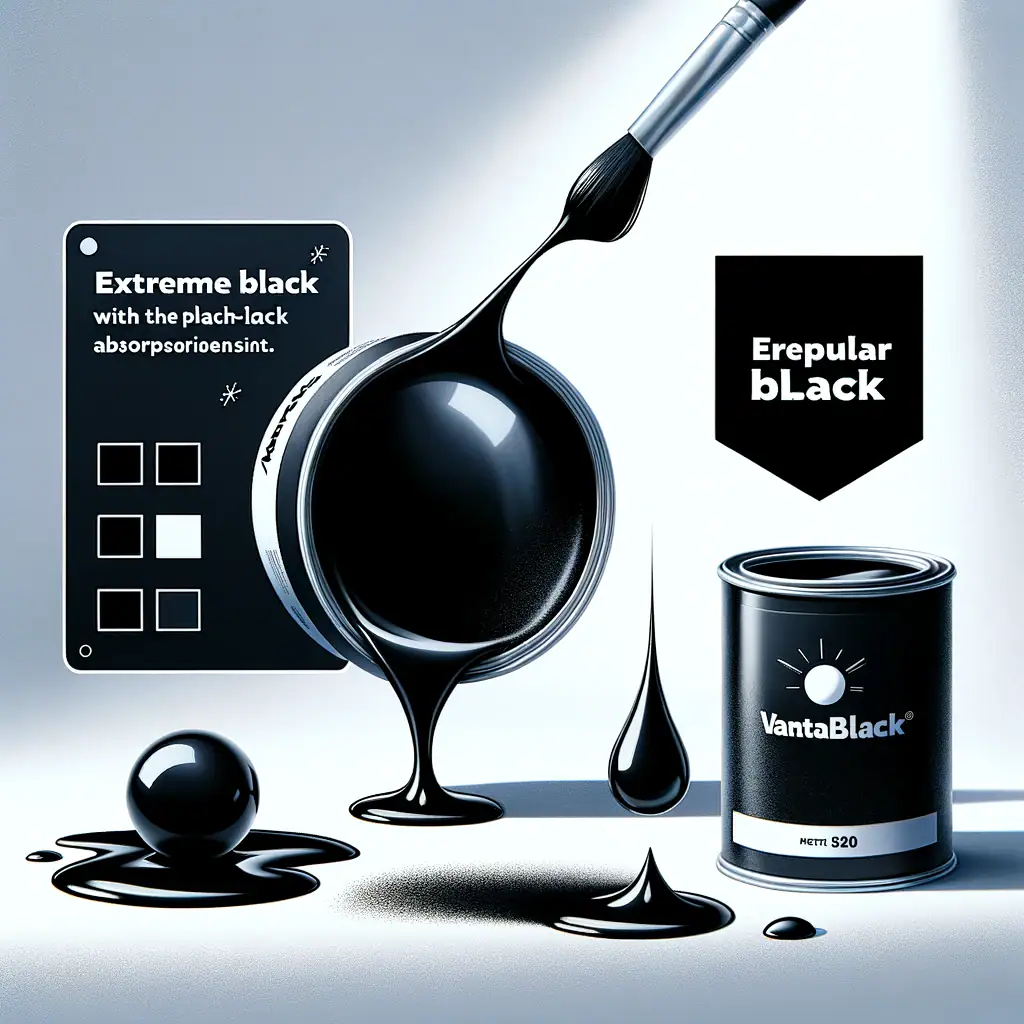
To create Vantablack paint, specific materials are essential. At the core of its formulation are carbon nanotubes, tubular carbon structures with remarkable properties. These nanotubes must be aligned vertically and uniformly, which requires suitable substrates and sophisticated chemical vapor deposition (CVD) processes. Other materials, such as catalysts and reactive gases, are also essential to promote the growth of carbon nanotubes.
The creation process requires a controlled environment, with precise temperature and pressure, to ensure the quality and uniformity of the paint. The equipment used for the production of Vantablack is highly specialized and must be capable of handling substances at the nanoscale, implying advanced technology and technical skills.
2.2 Production Steps
The production of Vantablack paint is a delicate process that occurs in several steps. First, substrate preparation is crucial, as the carbon nanotubes must adhere perfectly to the surface. Next, the chemical vapor deposition (CVD) process is implemented to grow the nanotubes on the substrate. This step involves the use of reactive gases and catalysts at very high temperatures to catalyze the growth of the nanotubes.
Once the carbon nanotubes are formed, they are processed and purified to ensure there are no defects and that the paint performs optimally. Finally, strict quality controls are carried out to ensure that the paint meets the required criteria for light absorption and durability. The success of these steps depends on mastering nanotechnology techniques and the expertise of the scientists and engineers involved.
2.3 Precautions and Safety
When handling and producing Vantablack paint, precautionary and safety measures are imperative. The handling of carbon nanotubes must be done under strict safety conditions to prevent inhalation or skin exposure. Personal protective equipment, such as respiratory masks and gloves, is essential to protect workers from any potential toxicity.
Furthermore, production processes must be carried out in controlled environments, with adequate ventilation systems to prevent air contamination. Existing regulations regarding working with nanomaterials must be meticulously followed to ensure operators’ safety and environmental compliance. Handling Vantablack therefore requires a deep knowledge of safety protocols and industrial standards.
3. Influences and Controversies Surrounding Vantablack Paint
3.1 Impact on the Art World
The arrival of Vantablack paint in the market has had a considerable impact on the art world. Artists quickly saw the potential of this paint to create works of an unprecedented deep black. The ability of Vantablack to absorb light and eliminate detail creates a disconcerting visual experience, questioning the perception of space and reality. However, the exclusivity granted to artist Anish Kapoor, who obtained the rights to use Vantablack in the artistic field, has sparked debates and tensions within the art community.
The power of this paint to radically transform the appearance of objects has inspired a new wave of creativity, pushing the boundaries between art, science, and technology. Nevertheless, the limited access to Vantablack and its high price continue to fuel discussions about the democratization of technology and intellectual property in the art world.
3.2 Legal and Ethical Controversies
The controversies surrounding Vantablack paint are not limited to the art world. Legal and ethical questions have been raised regarding the exclusivity of its use. Granting exclusive rights to a single artist has been perceived by some as a form of monopoly contrary to the spirit of sharing and innovation in the artistic field. This situation has led to a response in the form of alternative paints, such as BLACK 2.0 developed by Stuart Semple, which aims to make ultra-black paint more accessible to everyone.
Moreover, the safety of nanomaterials and their potential impact on the environment and health are concerns that must be taken into account. Safety procedures and regulations regarding nanotechnology are essential to ensure that the use of Vantablack does not pose unnecessary risks.
3.3 Future Perspectives
Despite the controversies, the future prospects of Vantablack paint appear promising. Its potential applications extend well beyond art and aesthetics, with possible implications in various fields such as solar energy, where its light absorption could improve the efficiency of photovoltaic cells, or in the automotive industry to reduce glare and enhance safety.
As technology evolves and production becomes more accessible, it is likely that new innovative uses for Vantablack will emerge. The challenges associated with its production and handling will continue to spark debates and advancements, both technically and ethically. The impact of ultra-black paint on society and culture remains to be observed, as it represents a fascinating example of how science can transform our perception of the world.