Free Shipping on Orders Over $50

General Overview of Newton’s Law of Cooling
Contenus
afficher
The law of cooling of Newton, a remarkable discovery in the field of thermodynamics, remains fundamental to our understanding of thermal transfer phenomena. It describes how the temperature of an object changes over time when subjected to an environment with a different temperature. This law is widely used in various scientific and industrial fields, ranging from engineering to environmental sciences.
The importance of this law lies in its ability to model and predict the thermal behavior of materials. It allows estimating the cooling or warming speed of a body, which is crucial in many practical applications, such as food safety, energy resource conservation, and even forensic science.
History and Contribution of Newton to Thermodynamics
Sir Isaac Newton, recognized for his major contributions in physics and mathematics, also left his mark in thermodynamics. In the 17th century, Newton formulated the law that now bears his name, thereby establishing a fundamental principle of heat transfer. This discovery was crucial for the subsequent development of thermal sciences and served as a foundation for many research efforts and technological advancements.
The law of cooling of Newton is often regarded as one of the first quantitative laws in thermodynamics. It remains relevant, despite the centuries that have passed, due to its simplicity and direct application in the real world. Newton’s recognition in this field highlights not only his genius but also the lasting impact of his work on the evolution of physical sciences.
Fundamental Principles of Newton’s Law of Cooling
The principles of the law of cooling of Newton are based on the observation that the cooling rate of an object is proportional to the difference between the object’s temperature and that of its environment. In other words, the greater the temperature difference, the faster the heat transfer. This principle is essential for understanding the thermal behavior of materials and for implementing effective temperature control measures.
This law applies under conditions where conduction, convection, and radiation can be considered linear. Although there are cases where these conditions are not perfectly met, Newton’s law of cooling provides a sufficiently accurate approximation for many practical situations, making it an invaluable tool
for engineers and scientists.

Select options
This product has multiple variants. The options may be chosen on the product page
Premium Newton’s Cradle
Price range: $34.99 through $80.99
Giant Newton’s Cradle
$206.99
Newton’s Cradle Stick
$160.99
Mathematical Formulation and Explanation of Newton’s Law of Cooling
Description of Newton’s Cooling Equation
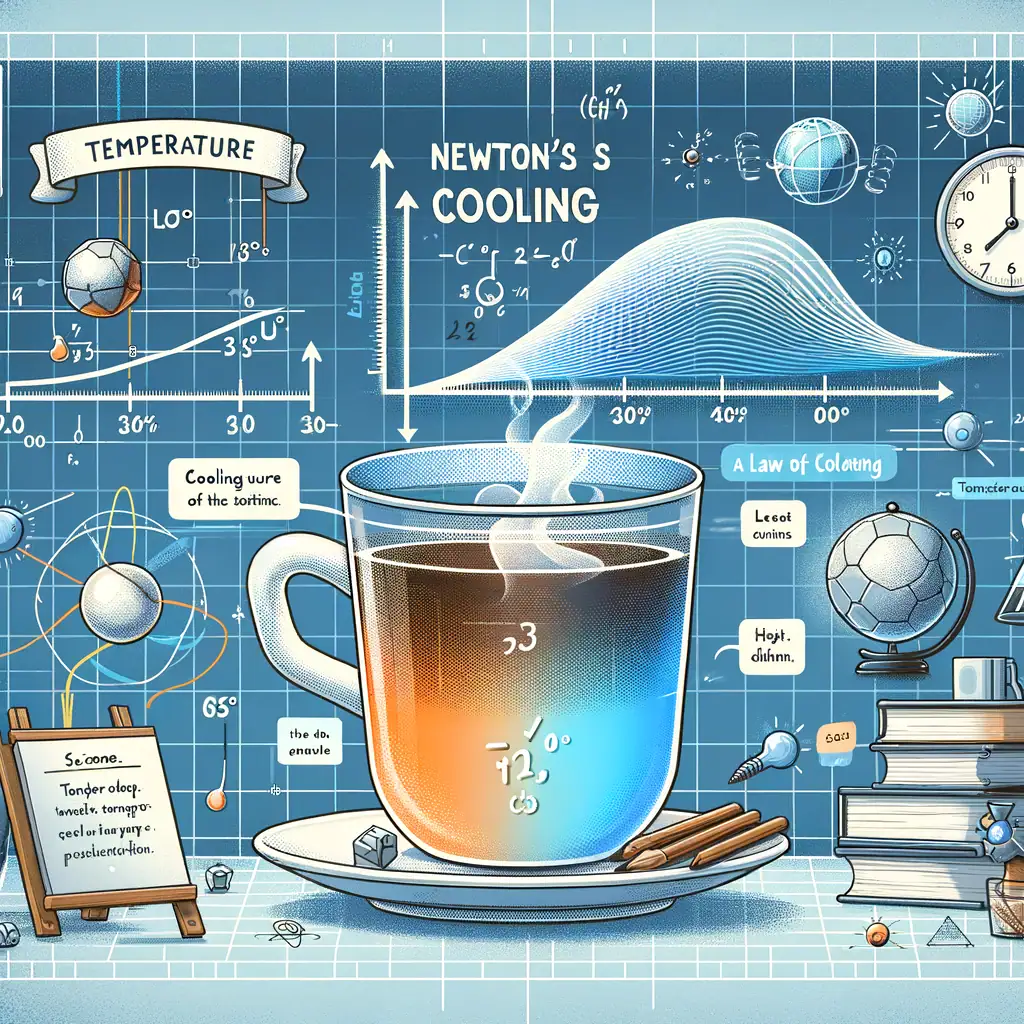
The equation of the law of cooling of Newton is expressed in the form of a linear differential relationship. This equation relates the temperature change of a body over time, taking into account the temperature of the environment and a heat transfer coefficient characteristic of the system. Mathematically, it is represented by the equation: dT/dt = -k(T – T_env), where T is the temperature of the body, T_env is the temperature of the environment, and k is the heat transfer coefficient.
Using this equation, it is possible to describe and predict the cooling or warming dynamics of bodies in various contexts. The mathematical approach offers a clear and quantifiable understanding of thermal processes, which is essential for the analysis and design of thermal systems.
Interpretation of Variables and Constants
The variables and constants present in the equation of Newton’s law of cooling play a crucial role in interpreting the results. The coefficient k, for example, represents the thermal properties of the material and the nature of the heat transfer. It varies depending on several factors, such as thermal conductivity, convection, and radiation.
The environmental temperature (T_env) is another determining element, as it serves as the reference from which the loss or gain of heat is measured. The accuracy with which these variables and constants are determined and applied in the equation directly influences the validity of the predictions obtained by Newton’s law of cooling.
Presentation of Assumptions and Limitations
It is essential to recognize the assumptions and limitations inherent in Newton’s law of cooling for appropriate use. This law assumes that heat transfer is uniform and that the properties of the material do not change with temperature. Furthermore, it is generally applicable in the linear regime, far from nonlinear phenomena such as forced convection or phase change.
These idealized conditions are not always encountered in practice, which can lead to discrepancies between theoretical predictions and experimental observations. This understanding of limitations allows users of Newton’s law of cooling to adjust their models and take into account factors that may affect the accuracy of the results.
Applications and Implications of Newton’s Law of Cooling
Use in Solving Practical Problems
The application of the law of cooling of Newton is vast and encompasses a multitude of practical problems. In the field of engineering, it is used to design efficient cooling systems, such as those found in vehicle engines or electronic equipment. In forensic science, it helps determine the time of death by analyzing the body’s cooling rate.
Moreover, this law is critically important in the food industry, where it helps calculate the necessary cooling times to prevent bacterial growth and ensure product safety. Thus, the applications of this law are concrete and have a direct impact on our daily lives and our safety.
Impact on Modern Technologies
Newton’s law of cooling has a profound impact on the development of modern technologies. For instance, in the renewable energy sector, it helps optimize the thermal dissipation of solar panels, thus contributing to their efficiency and durability. It also plays a role in the design of energy-efficient buildings, influencing heating, ventilation, and air conditioning (HVAC) systems.
The contribution of this law is not limited to current innovations; it continues to play an essential role in the research and development of new technologies. The thermal analysis it enables is indispensable for addressing future challenges, such as thermal waste management and the miniaturization of electronic components.
Contribution to Scientific Understanding of the World
The contribution of the law of cooling of Newton to our understanding of the world is undeniable. It provides a framework for studying natural thermal processes, such as heat dissipation in ecosystems or the cooling of volcanic rocks. This law enriches our understanding of thermal phenomena and serves as a starting point for more complex modeling.
In summary, Newton’s law of cooling remains an essential element in the field of thermodynamics. It perfectly illustrates how a simple mathematical relationship can have significant repercussions on science, technology, and many other spheres of human life.