Free Shipping on Orders Over $50

The Newton’s pendulum is much more than just an intriguing decorative object. Used in physics to clearly and visually illustrate fundamental principles like conservation of energy and conservation of momentum, it has become a classic that is both educational and symbolic. Whether in a classroom, an office, or as a modern decorative element, it fascinates both the curious and science enthusiasts. Let’s discover together how it works, its practical uses, and the criteria for choosing it well.
Contenus
afficher
What is a Newton’s pendulum?
Origin and invention
The Newton’s pendulum was not directly invented by Isaac Newton, but it bears his name because it dramatically illustrates his fundamental laws of mechanics. The object was popularized in the 17th century, a time marked by great scientific discoveries. It is notably inspired by Newton’s work on conservation of momentum and conservation of energy. Later, in the 20th century, the pendulum became a widely used tool for scientific popularization in schools, laboratories, and even interactive museums.
Over time, it has transcended the simple scientific framework to also become an iconic decorative object, found in many offices and modern interiors, symbolizing both scientific rigor and aesthetic balance.
Description and main components
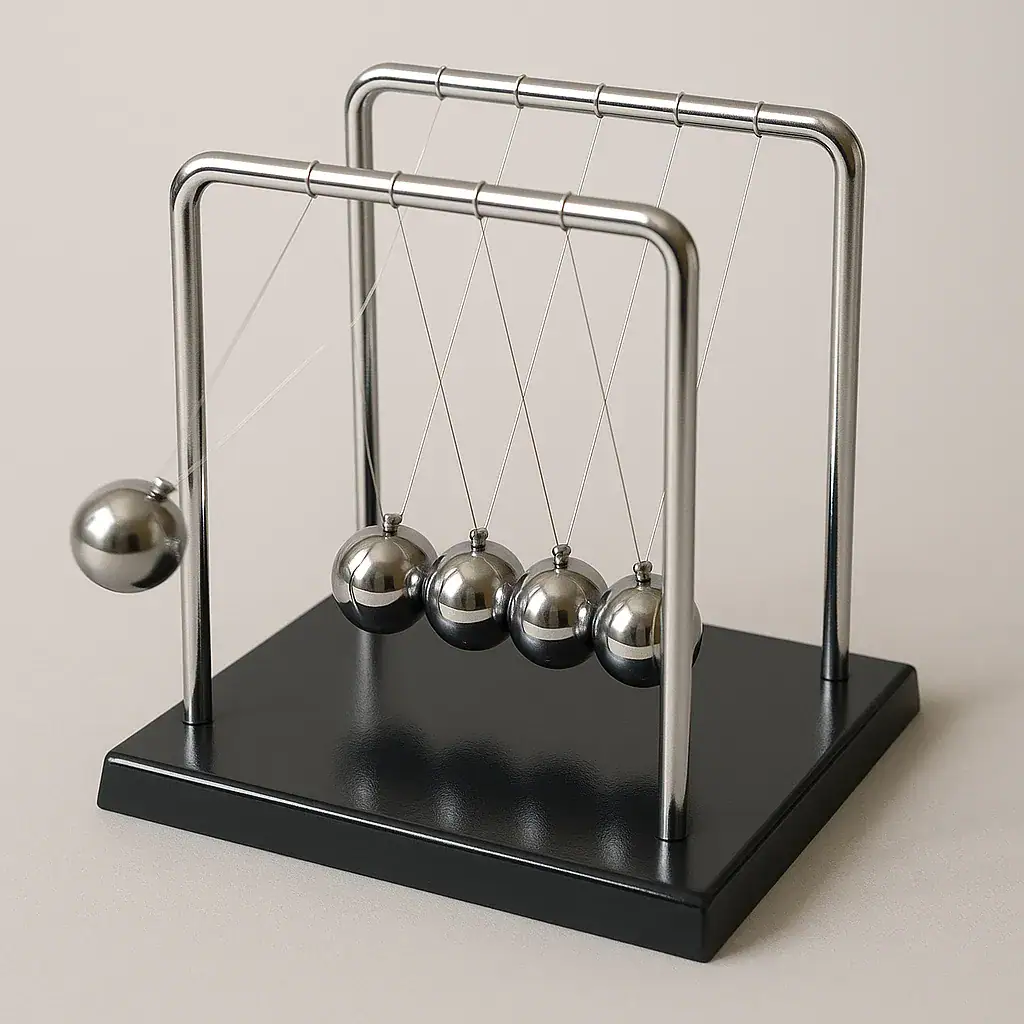
The Newton’s pendulum is a device that is both simple and ingenious. It consists of several essential elements:
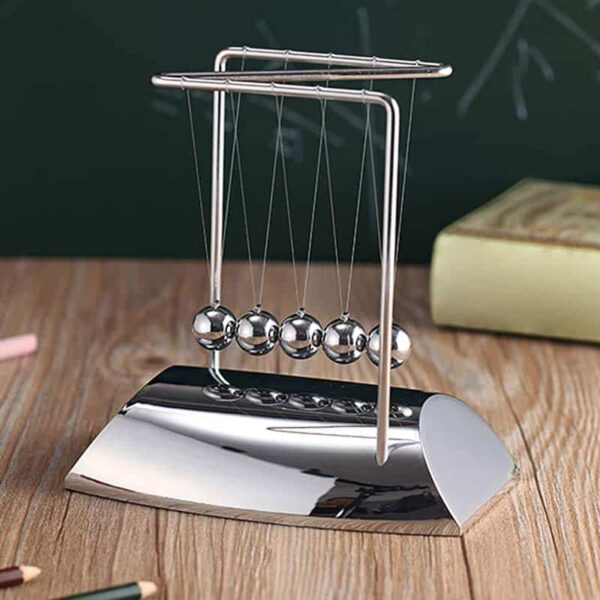
- The metallic balls: identical in size and mass, usually made of polished steel, they ensure optimal transmission of energy and motion.
- The suspension system: made of threads, fine cables, or sometimes nylon filaments, it keeps each ball perfectly aligned and allows for free movement without excessive friction.
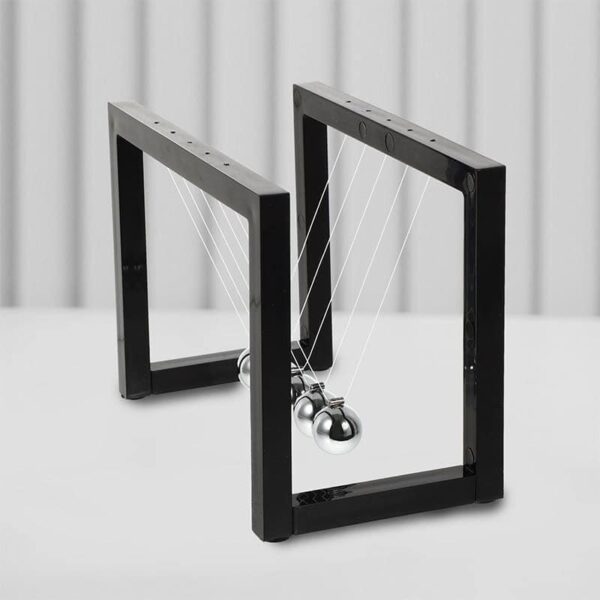
- The rigid frame or support: often made of wood, metal, or reinforced plastic, it ensures the stability of the entire assembly and prevents any lateral deviation of the balls.
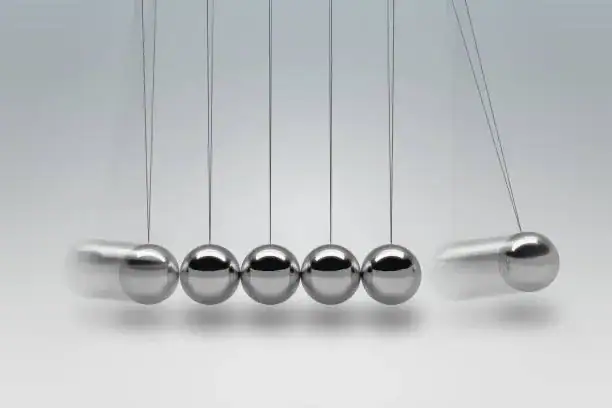
When one or more balls are lifted on one side and released, they collide with the stationary balls. The energy and momentum are then transmitted instantly through the row, propelling the opposite ball. This phenomenon creates a striking visual effect that illustrates both the accuracy of Newton’s laws and the beauty of a physical system in action.
The simplicity of its design actually conceals great precision: if the balls are not perfectly aligned, if their mass varies, or if the suspensions are not identical, the effect loses its effectiveness. This is why quality pendulums are designed with particular care in alignment and symmetry.
How does a Newton’s pendulum work?
Select options
This product has multiple variants. The options may be chosen on the product page
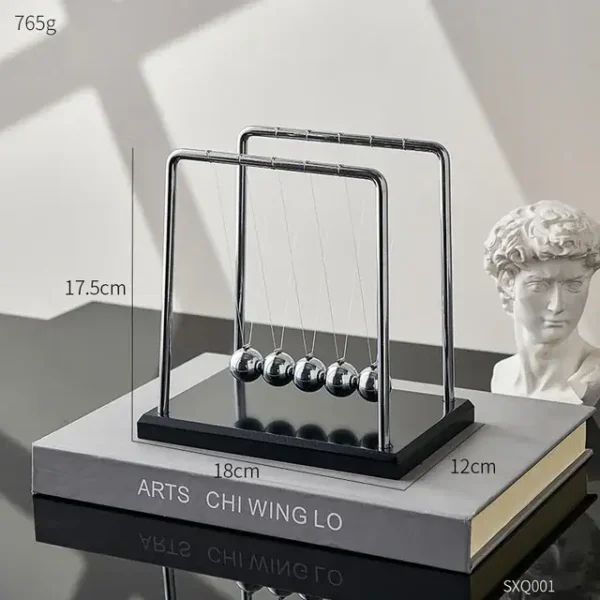
Premium Newton’s Cradle
Price range: $34.99 through $80.99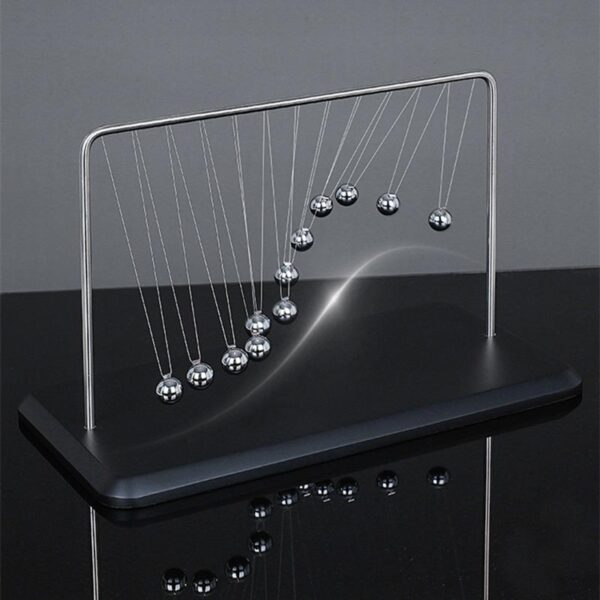
Giant Newton’s Cradle
$206.99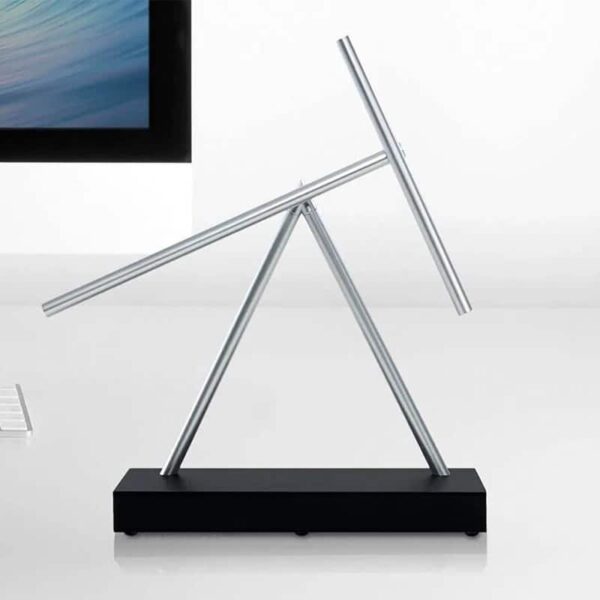
Newton’s Cradle Stick
$160.99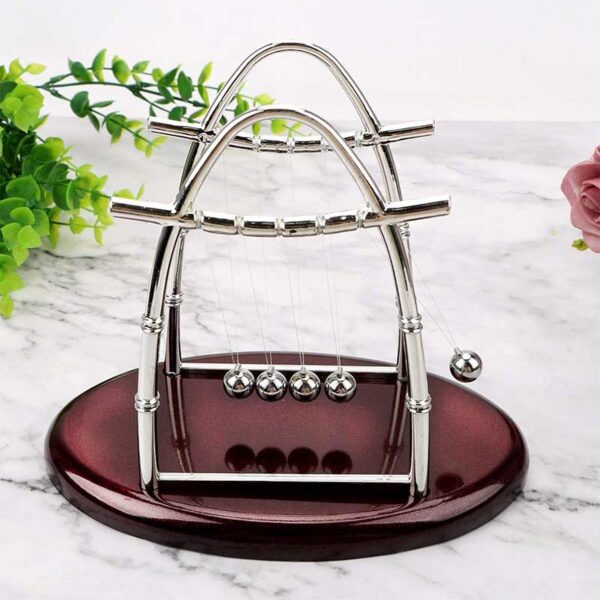
Principle of conservation of energy
The Newton’s pendulum primarily relies on conservation of mechanical energy. When a ball is lifted, it accumulates gravitational potential energy proportional to its height. Upon release, this energy transforms into kinetic energy (energy of motion). During the collision with the next ball, the energy is transmitted through the row almost instantly, emerging at the other end. The opposite ball then rises to a height almost identical to that of the starting ball.
This process visually and intuitively demonstrates that energy does not disappear: it simply changes form and direction. This is why the Newton’s pendulum is used in physics classes to illustrate the transformation and conservation of energy.
Principle of conservation of momentum
In addition to energy, the pendulum illustrates the conservation of momentum. This is defined by the product of an object’s mass and its velocity. When a moving ball collides with the others, the total momentum of the system remains constant. This explains why, when a single ball is released, only one ball exits on the other side at the same speed. Similarly, if two balls are lifted, two balls emerge on the opposite side, and so forth.
This phenomenon is made possible because the collisions are said to be quasi-elastic: there is very little energy loss during impact, unlike inelastic collisions where the objects would deform significantly or stick together.
Why does the movement eventually stop?
In an ideal theoretical system without losses, the movement could last indefinitely. But in reality, several factors lead to a gradual dissipation of energy:
- Air friction: the balls displace air as they oscillate, which reduces their energy over time.
- Heat and sound loss: during each impact, a small part of the energy is dissipated in the form of heat and noise.
- Material deformation: even if minimal, the imperfect elasticity of the balls results in a loss of efficiency in energy transmission.
- Alignment imperfections: if the balls are not perfectly positioned, some energy is lost in spurious movements.
These cumulative losses cause the amplitude of movement to gradually decrease until it comes to a complete stop. In practice, a Newton’s pendulum can oscillate for several dozen seconds to several minutes depending on the quality of materials and the precision of assembly.
Thus, the Newton’s pendulum is not a perpetual motion device, but an elegant and accessible illustration of Newton’s laws and classical mechanics.
What is a Newton’s pendulum used for?
Select options
This product has multiple variants. The options may be chosen on the product page
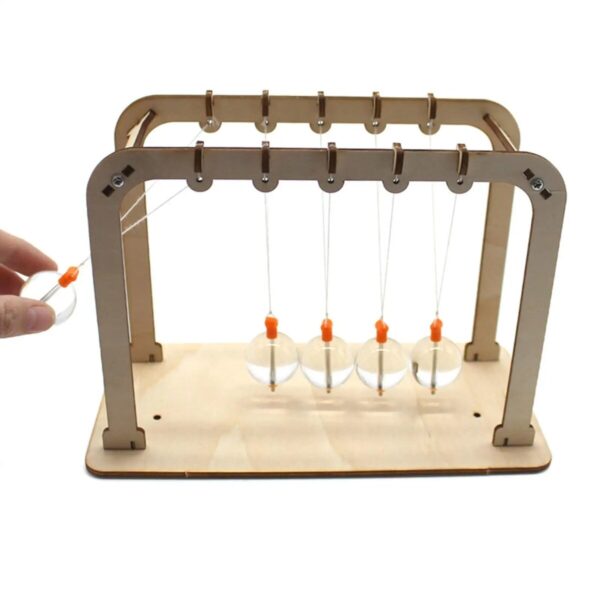
An educational tool in physics
The Newton’s pendulum is one of the most used objects in teaching physical sciences. It allows for the live illustration of fundamental concepts such as:
- Conservation of mechanical energy (transition from potential energy to kinetic energy).
- Conservation of momentum during collisions.
- The difference between elastic and inelastic collisions.
Its interest lies in making abstract phenomena visible. In just a few seconds, students see that energy is not lost but simply transmitted. This tool is therefore highly valued by physics teachers and science educators in museums or educational workshops.
A decorative and relaxing object
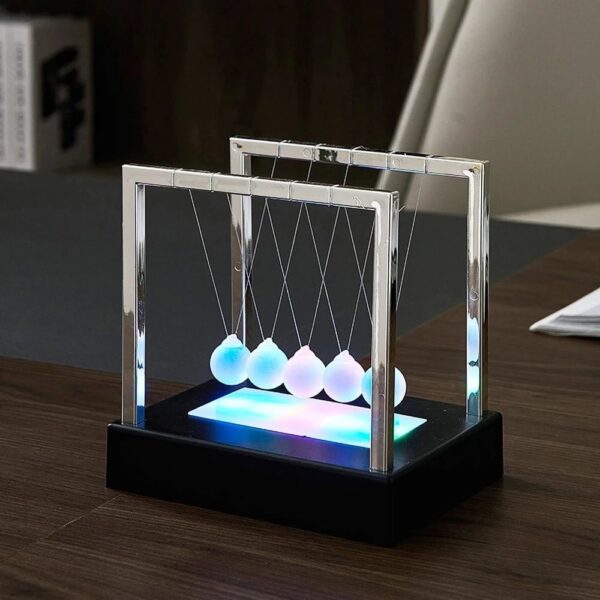
Beyond science, the Newton’s pendulum is also appreciated as a decorative object. Placed on a desk or shelf, it immediately attracts the eye with its regular and harmonious movement. Its swinging produces a calming effect, comparable to that of a metronome or an indoor fountain.
Many users use it as an anti-stress object: watching the balls collide fluidly provides a sense of calm and helps concentration. This is why it is often found in workspaces, libraries, or even modern living rooms with minimalist design.
A symbol of productivity and balance
In the professional world, the Newton’s pendulum has become a true symbolic icon. It embodies:
- Causality: every action has a consequence, visible through the movement of the balls.
- Continuity: a logical sequence of events that follow one another without interruption.
- Balance: a visual reminder of the need to find a stable rhythm between work, rest, and decision-making.
It is common to see them in meeting rooms, where it symbolizes the importance of reflection and collective movement. Some managers even use it as a visual aid during presentations to emphasize the impact of choices and team collaboration.
Applications in business and management
In businesses, the Newton’s pendulum goes beyond mere decoration. It can be used as a management metaphor or as a visual communication tool:
- Chain reaction: an isolated decision can have multiple consequences on the entire project.
- Team synergy: each member plays a role, and the whole only functions properly if everything is aligned.
- Individual responsibility: a single action can trigger a measurable impact, whether positive or negative.
- Innovation and continuity: symbolizes the need to balance new ideas with organizational stability.
This dual role – scientific and symbolic – explains why the Newton’s pendulum remains both a learning tool, a decorative element, and a support for reflection in many contexts.
Comparison table: Newton’s pendulum vs other scientific objects
The Newton’s pendulum is not the only object used to illustrate the laws of physics or for decoration. Here is a detailed comparison with other pedagogical and scientific devices:
| Objet | Principle Demonstrated | Main Function | Advantages | Limitations | Target Audience |
|---|---|---|---|---|---|
| Newton's Cradle | Conservation of energy and momentum | Demonstration of elastic collisions | Highly visual and intuitive Dual use: science and decoration Iconic object (balance, productivity) | Does not run forever (energy loss) Fragile if mishandled | Students, teachers, modern offices |
| Simple Pendulum | Oscillation, gravity, period of motion | Study of timekeeping and gravity | Historic experiment (Galileo) Easy to build yourself Helps understand the concept of period | Less spectacular Single function | Schools, science enthusiasts, watchmaking |
| Gyroscope | Stability through rotation and angular momentum | Demonstrate the gyroscopic effect | Used in navigation and aeronautics Real-world applications (airplanes, satellites) Fun object (spinning tops, games) | Less decorative More complex explanation | Engineers, researchers, mechanics enthusiasts |
| Plasma Ball | Electricity and luminous discharges | Observation of electric arcs | Fascinating visual effect Ideal for capturing attention during demonstrations | No educational value in mechanics Requires electricity | General public, science and decor enthusiasts |
| Magnetic Spinning Top | Magnetism and rotation | Scientific toy and decorative piece | Fun and accessible Shows the effect of magnetic fields | Limited duration Less scientifically precise | Children, curious minds, gadget lovers |
Practical cases: where is the Newton’s pendulum used?
In classrooms and laboratories
The Newton’s pendulum is an indispensable educational tool to make science come alive. Teachers use it to:
- Demonstrate concretely the conservation of energy and momentum.
- Introduce students to the concept of elastic collision, easier to understand through experience rather than theory alone.
- Stimulate attention by providing an interactive and visual experience that leaves an impression.
In laboratories, it is sometimes used to test mechanical hypotheses or to introduce more complex experiments. Its simplicity makes it a perfect instrument for beginners in experimental physics.
In open spaces and offices
At work, the Newton’s pendulum is not just a design object: it is also a symbol of reflection and productivity. It is often used to:
- Add a touch of visual relaxation in open spaces, comparable to an anti-stress object.
- Illustrate causality during meetings or managerial presentations.
- Serve as a metaphor for synergy: each ball represents a team member, and the overall balance depends on collective action.
Its regular movement is also used as a concentration tool, similar to a silent clock or a visual metronome.
In art and interior decoration
Thanks to its minimalist structure and hypnotic movement, the Newton’s pendulum has found its place in the realms of design and contemporary art. It can be found:
- In modern and minimalist spaces, as an elegant decorative element.
- In art installations, sometimes enlarged or transformed into giant sculptures.
- As a conversation piece, intriguing visitors with its perfect balance.
Some designers even draw inspiration from it to create derivative objects (lamps, sculptures, interactive works), extending the idea of perpetual motion and mechanical harmony.
In popular culture and entertainment
The Newton’s pendulum also appears in movies, series, and advertisements, where it symbolizes the passage of time, relentless logic, or the snowball effect. It is also found in certain board games or educational gadgets that incorporate its principle to introduce children to the laws of physics in a playful way.
Expert tips for choosing your Newton’s pendulum
Size and design according to use (educational or decorative)
The choice of format depends on the objective:
- Educational use: choose a large and stable model (minimum 6 to 8 Inch in width) so that the movement is clearly visible to a group of students. Larger pendulums also offer better accuracy in energy transmission.
- Decorative use: a compact and elegant format (4 to 6 Inch) is more than sufficient. Miniature versions are ideal for a desk, while design or stylized models fit well into a modern living room.
- Professional use (offices, meeting rooms): prefer a medium-sized model with a sober design that balances aesthetics and robustness.
Materials and robustness
The quality of materials determines the durability and fluidity of movement:
- Polished stainless steel balls: ensure better energy transfer and resist corrosion.
- Nylon or fine steel suspension threads: provide stable alignment and limit wear.
- Wood or metal frame: adds strength and a refined aesthetic touch.
- Avoid: cheap plastic versions, too light and often misaligned, which quickly lose their scientific and visual interest.
Price and value for money
The price of a Newton’s pendulum varies based on its size, materials, and level of finish:
- Entry-level ($16 to $32): decorative models, often small, suitable as a gadget or simple gift but less durable.
- Mid-range ($32 to $88): sturdy pendulums with a good balance between aesthetics and precision, ideal for a desk or occasional educational use.
- High-end ($88 to $440 and above): large models, premium materials, perfect alignment, often used in higher education, in museums, or as exceptional design pieces.
Investing in a slightly more expensive model is recommended if you want an object that is both durable, precise, and elegant. The Newton’s pendulum is not just a gadget: it is a piece that can last for years if chosen well.
FAQ about the Newton’s pendulum
How long does the movement last?
On average, 30 seconds to a few minutes. This depends on the quality of the materials and the reduction of friction.
Can it be used as a relaxation tool?
Yes. Many use it as a stress-relief object, similar to a fidget or a visual stress ball.
What is the difference between a real scientific pendulum and a decorative gadget?
A true educational model is designed precisely to minimize energy losses. Decorative versions prioritize design at the expense of precision.
Where to buy a quality Newton’s pendulum?
You can find them in science stores, in decor shops, or on specialized scientific object websites. For a reliable version, it’s best to choose a recognized distributor.
Conclusion
The Newton’s pendulum is a fascinating object that combines science, aesthetics, and symbolism. Whether you are a student, a physics enthusiast, or simply looking for an elegant decorative object, it perfectly embodies the balance between pedagogy and design. A timeless classic that continues to captivate and inspire.