Free Shipping on Orders Over $50

The gyroscopic effect refers to the ability of a rotating object to maintain its orientation, even when an external force attempts to divert it. It is due to this phenomenon that a bicycle stands upright while rolling, that an airplane remains stable in flight, or that a satellite can orient itself in space. In this article, we will explore in detail the scientific basics, its practical applications, its advantages and limitations, as well as practical tips for observing it yourself.
Contenus
afficher
What is the gyroscopic effect?
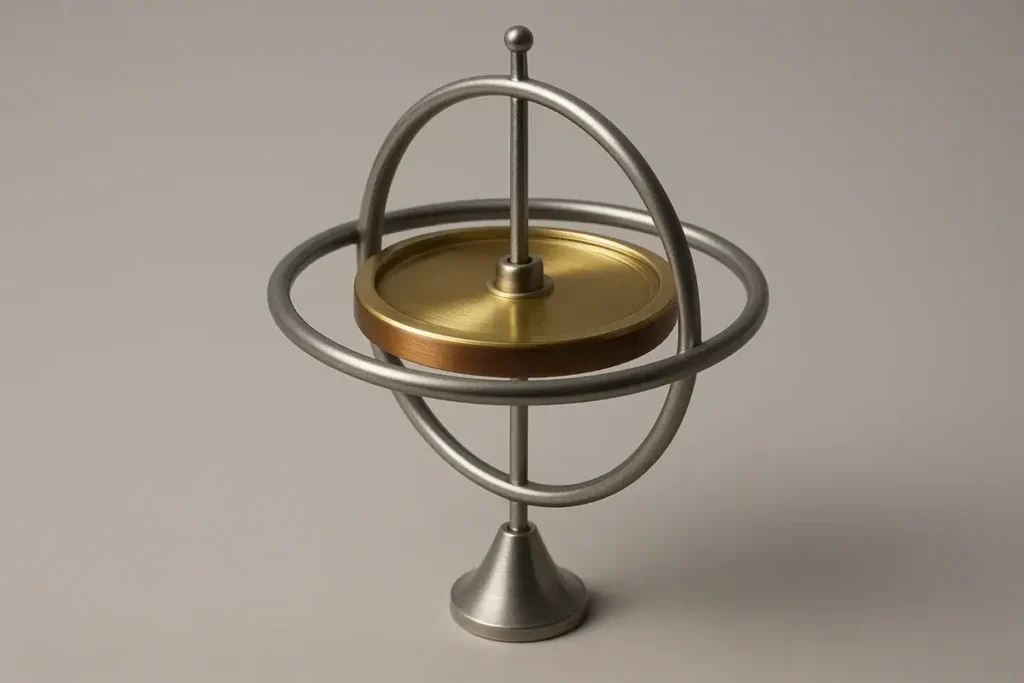
The gyroscopic effect is a physical phenomenon that occurs when a rapidly rotating object tends to maintain its orientation, despite external forces trying to divert it. It relies on the principle of angular momentum, a quantity that measures the rotational motion of a body.
In other words, the faster an object spins and the more mass it has distributed far from its axis (like a wheel or a disc), the harder it becomes to change its trajectory. This is why a top, a gyroscope, or a bicycle wheel stands upright in motion but falls quickly when at rest.
Simple definition
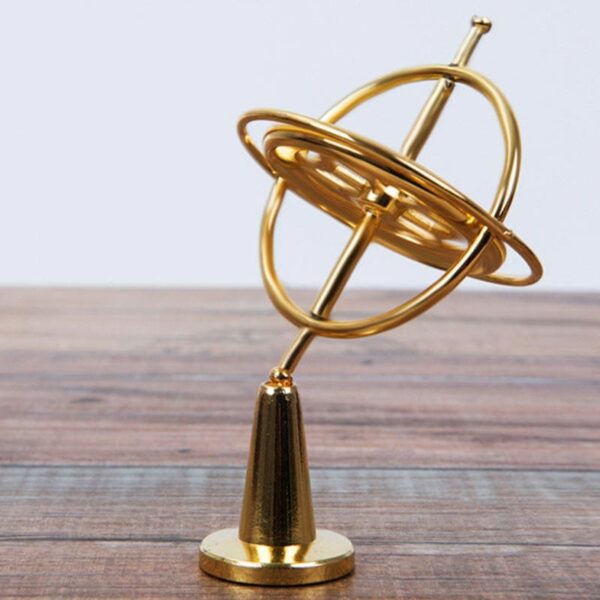
A gyroscope is a device designed to take advantage of this phenomenon. It maintains a stable orientation through rapid rotation and resists changes in direction imposed by external forces. This is why they are found in airplanes, ships, and smartphones.
Concrete example
Imagine you are holding a bicycle wheel by its axle. If it is stationary, it easily tips over. But if it spins at high speed, you feel resistance when you try to tilt it. This is precisely the gyroscopic effect in action.
Select options
This product has multiple variants. The options may be chosen on the product page
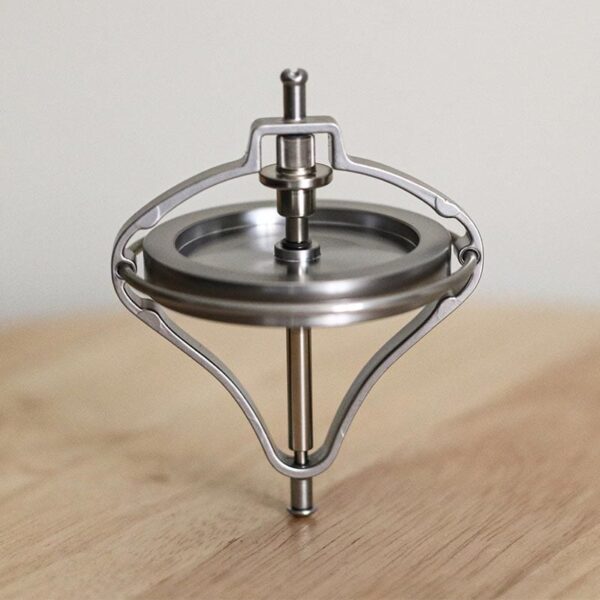
Gyroscope Wheel
$9.99Key principle
The determining factor is the rotational speed: the faster an object spins, the higher its angular momentum, and the greater its stability. Conversely, as the speed decreases, the effect diminishes until it disappears, and the object regains its susceptibility to external disturbances.
A phenomenon found everywhere
The gyroscopic effect is not limited to wheels or tops. It can be found in:
- Vehicles: stability of motorcycles and bicycles in motion.
- Aerospace: sensors and navigation instruments.
- Space: orientation of satellites and probes.
- Everyday objects: toys, spinners, and even motion sensors in smartphones.
The scientific basics of the gyroscopic effect
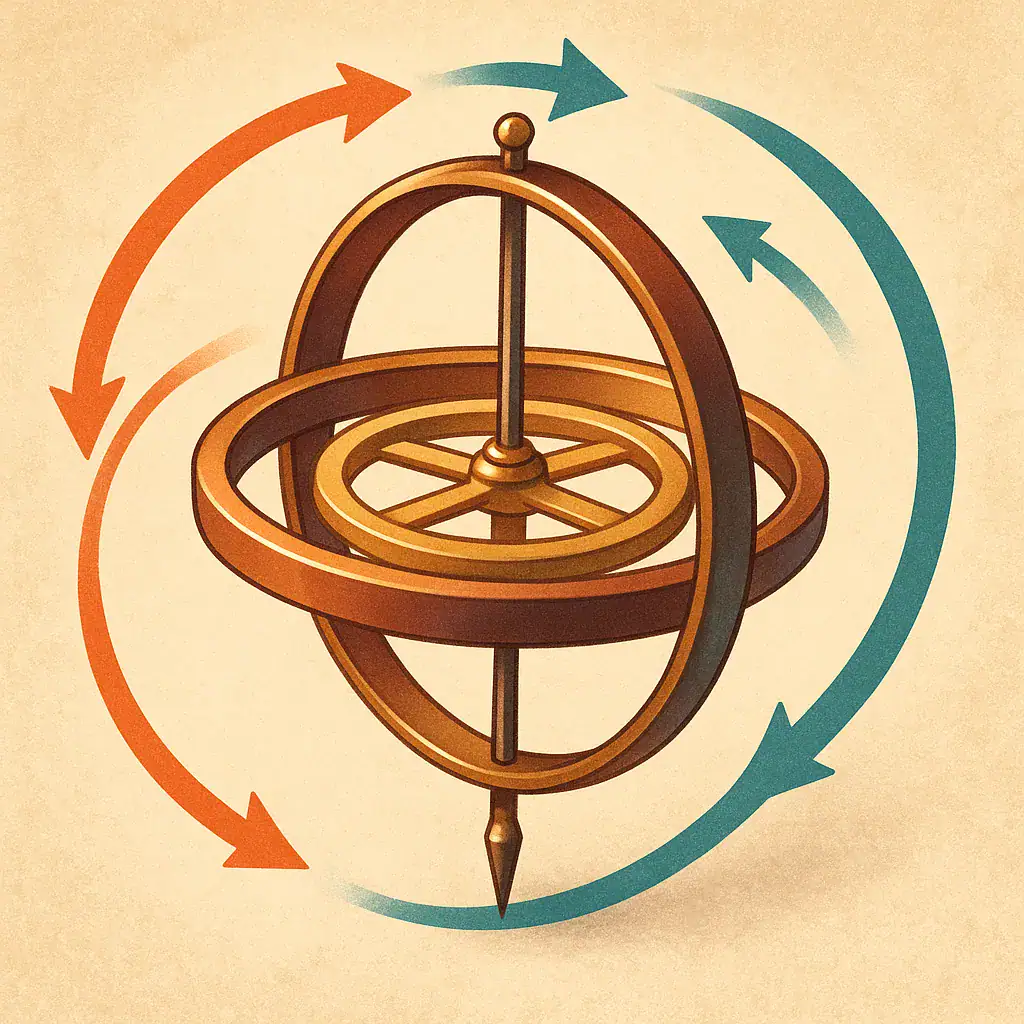
To understand the gyroscopic effect, we must return to the fundamental laws of mechanics, particularly the concept of angular momentum. These principles help explain why a rotating object behaves differently than a stationary one.
Angular momentum
Angular momentum is a physical quantity measuring the amount of rotational motion of a body. It depends on three factors:
- The mass of the object: the heavier it is, the greater its angular momentum.
- The rotational speed: the faster it spins, the more stable it is.
- The mass distribution: if the mass is far from the axis (like a wheel), the effect is amplified.
Concretely, a spinning bicycle wheel has high angular momentum, which explains the difficulty in changing its orientation compared to a stationary wheel.
Conservation of angular momentum
Just as energy is not lost but transformed, angular momentum (another name for angular momentum) is conserved as long as no external force comes to alter it. This means that a rapidly rotating object tends to stay in the same state.
A classic example: a top that spins maintains its vertical axis of rotation. It does not fall immediately because its angular momentum opposes the force of gravity. As it slows down, the effect weakens, and it eventually tips over.
Select options
This product has multiple variants. The options may be chosen on the product page
Precision Gyroscope
$22.99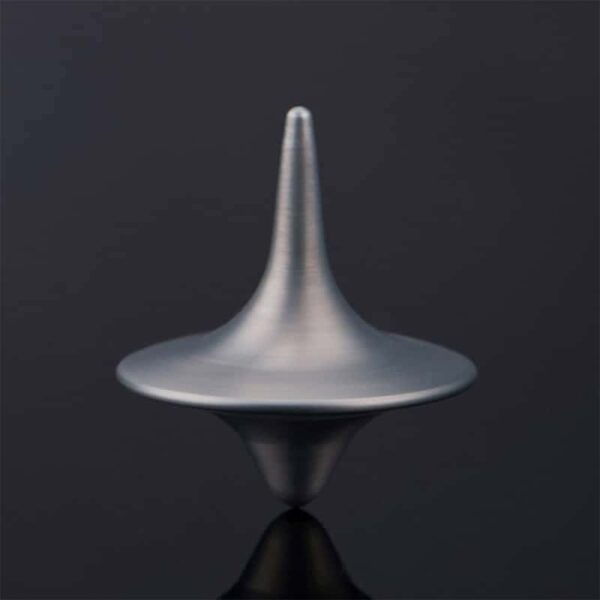
Precession and nutation
When a force acts on a rotating object, it does not tip directly. Instead, it describes a specific movement called precession. This is a gradual deviation of the axis of rotation, visible for example on a top that starts to tilt slightly instead of falling.
This can be accompanied by nutation, a rapid and irregular oscillation of the axis of rotation. This phenomenon is well known to physicists, but it can also be observed by anyone: when a top wobbles before stopping, it combines precession and nutation.
To remember: the gyroscopic effect relies on three fundamental concepts — angular momentum, its conservation, and the particular movements (precession, nutation) that appear when an external force acts. These principles explain why a moving wheel or a top seems to “defy” gravity.
Concrete applications in daily life
Far from being a curiosity confined to physics laboratories, the gyroscopic effect is present in many aspects of our daily life. It ensures the stability, orientation, and precision of objects ranging from children’s toys to spacecraft. Here are the main areas where it is involved:
- Bicycle and motorcycle: the rotation of the wheels generates a gyroscopic effect that contributes to stability in motion. This is one reason why a bicycle may seem to “stand on its own” when riding but topples immediately when stopped.
- Aerospace: airplanes use gyroscopes in their cockpit instruments (artificial horizon, autopilot) to maintain orientation and avoid losing reference points mid-flight.
- Maritime navigation: modern ships are equipped with precision gyroscopes that allow them to maintain a stable course, even in rough seas or storms.
- Space technology: satellites, rockets, and interplanetary probes use electronic gyroscopes (often fiber optic or laser-based) to orient themselves with extreme precision, without relying on external reference points.
- Wearable technology: our smartphones, smartwatches, and video game consoles are equipped with gyroscopic sensors capable of detecting even the slightest movements and tilts, enabling augmented reality or video stabilization.
- Everyday objects: toys such as tops, stress relief spinners, or educational gyroscopes illustrate this phenomenon in a fun and educational way.
Comparative table: gyroscopic effect vs other principles of stability
| Principle | Characteristics | Advantages | Limitations | Examples |
|---|---|---|---|---|
| Gyroscopic Effect | Stability ensured by rotation and conservation of angular momentum. | Enables dynamic stabilization, even without external support. | Requires an energy source to sustain rotation. | Bicycle wheel, spinning top, satellites, smartphones. |
| Static Equilibrium | Object is stable when its center of gravity is well positioned and its base is wide enough. | No energy required, permanent stability as long as conditions remain fixed. | Can tip over if the center of gravity moves beyond the base of support. | Pyramids, chairs, Eiffel Tower. |
| Dynamic Equilibrium | Stability achieved through continuous movement and constant adjustment. | Maintains balance even in unstable situations. | Heavily depends on movement and user intervention. | Cyclist in motion, airplane in flight, tightrope walker. |
| Mechanical Stabilization | Use of counterweights or dampers to balance a system. | Highly effective at absorbing vibrations and shocks. | Can be heavy, expensive, and limited to specific uses. | Cranes, cameras with mechanical stabilizers. |
Advantages and limitations of the gyroscopic effect
The advantages
- Increased stability: essential for vehicles, airplanes, and ships.
- Precision: used in navigation instruments and electronic sensors.
- Versatility: varied applications from toys to space exploration.
The limitations
- Energy consumption: maintaining rapid rotation requires energy.
- Mechanical constraints: wear and tear on materials at high speeds.
- Technical complexity: calibration and maintenance required for precision gyroscopes.
Expert tips: how to experiment and observe the gyroscopic effect
- At home: spin a bicycle wheel held by its axle and try to tilt it.
- In class: use a top or a toy gyroscope to illustrate the phenomenon to students.
- In a science workshop: compare the stability of a rapidly rotating object vs a slowly rotating one.
Mistakes to avoid when studying or explaining the gyroscopic effect
- Confusing with centrifugal force: these are two different phenomena.
- Attributing all bike balance to the gyroscope: the effect plays a role, but direction and geometry matter too.
- Forgetting the limitations: a gyroscope does not make an object indestructible or completely stable without constraints.

Select options
This product has multiple variants. The options may be chosen on the product page
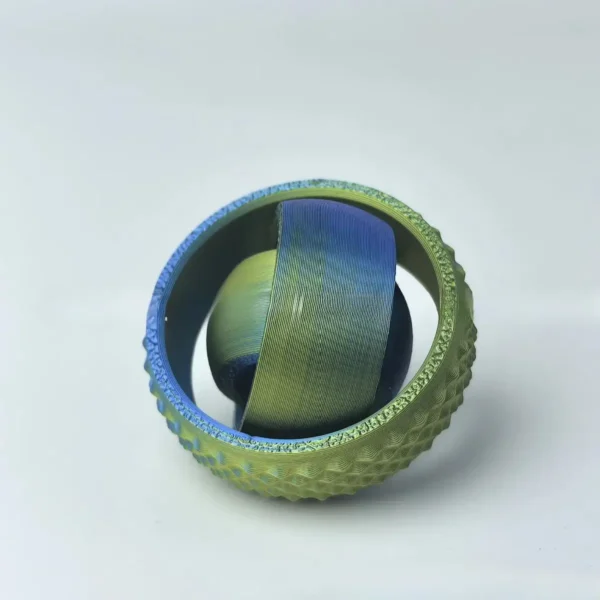
Gyroscope Ball
$19.99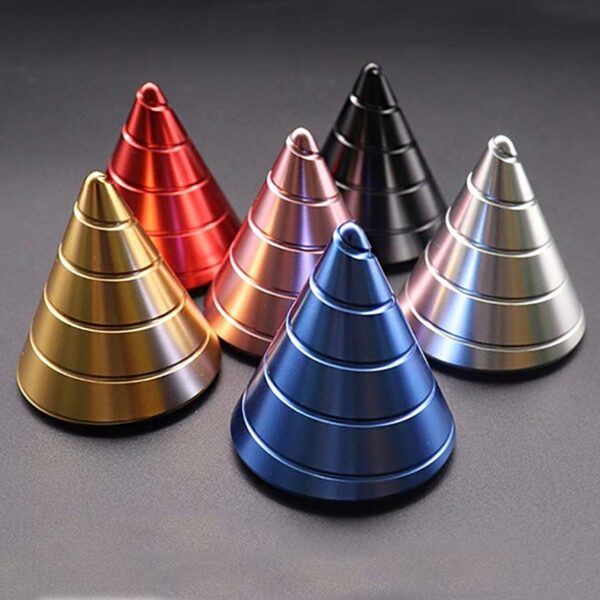
Select options
This product has multiple variants. The options may be chosen on the product page
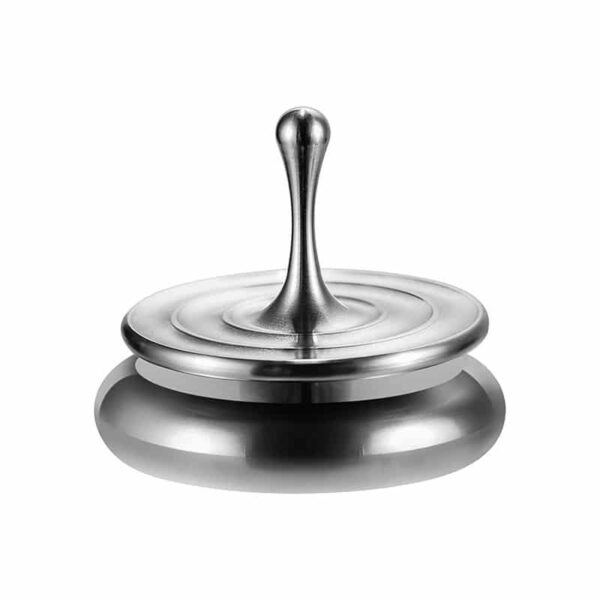
Gyroscopic Cone
$22.99
FAQ: frequently asked questions about the gyroscopic effect
Why does a bicycle wheel stay upright when it spins?
Because in rotation, the wheel develops angular momentum that makes it resistant to changes in direction. This is the gyroscopic effect.
What is the difference between a mechanical and an electronic gyroscope?
A mechanical gyroscope uses a spinning wheel, while an electronic gyroscope relies on MEMS or fiber optic sensors to measure movements.
Can the gyroscopic effect be used in medicine or biology?
Yes, it can be found in some assisted surgery tools and in biomechanics research to analyze body movements.
Does the effect work in space without gravity?
Absolutely. The gyroscopic effect does not depend on gravity but on rotation and angular momentum. This is why satellites use gyroscopes to orient themselves.
Conclusion
The gyroscopic effect demonstrates how a simple physical principle can have extraordinary applications. From the stability of a bicycle to the guidance of satellites, it remains a pillar of modern mechanics. Understanding its foundations not only allows one to grasp its usefulness but also to avoid misconceptions. A phenomenon that continues to inspire engineers, scientists, and physics enthusiasts.