Free Shipping on Orders Over $50

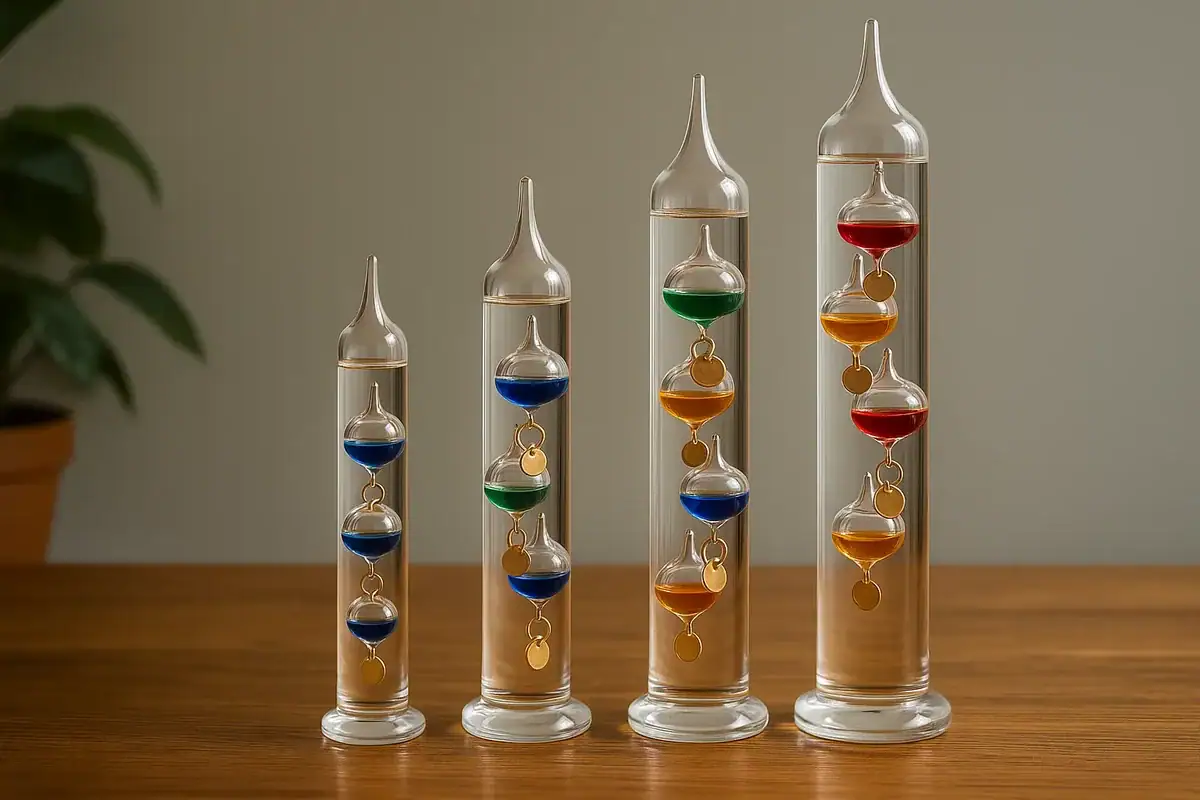
A Galileo thermometer works based on a simple principle: the variation of density of liquids and objects according to temperature. The small glass bulbs float or sink depending on the ambient heat, thereby indicating the temperature. In this article, we will detail its origin, its precise mechanism, its uses, its limitations, and answer the most frequently asked questions to understand everything about this object that is both scientific and decorative.
Contenus
afficher
Origin and Principle of the Galileo Thermometer
Who was Galileo and why is his name associated with this object?
Galileo (1564-1642), the famous Italian astronomer and physicist, did not directly invent the thermometer that bears his name, but he studied the dilation of liquids in depth. His research paved the way for thermoscopes and modern thermometers. The name “Galileo thermometer” pays tribute to his work on the physical properties of matter.
Basic Scientific Principle: Density and Buoyancy
The operation relies on the Archimedes’ principle: an object submerged in a liquid experiences an upward force equal to the weight of the volume of liquid displaced. Each bulb has a slightly different density. When the temperature varies, the density of the liquid changes, causing certain bulbs to rise or fall.
Components of a Galileo Thermometer
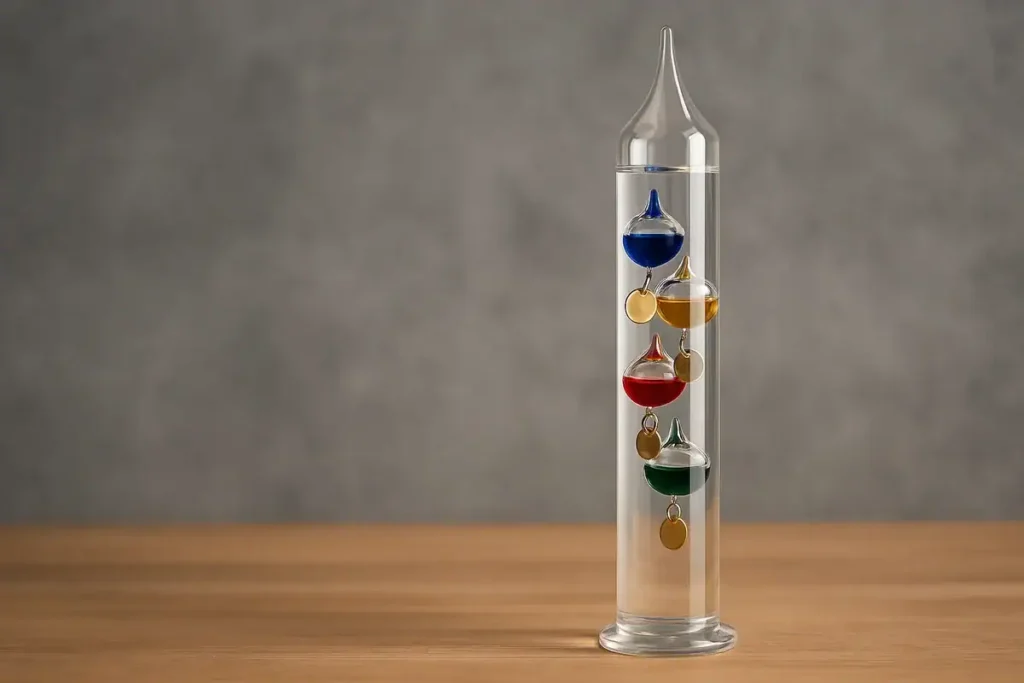
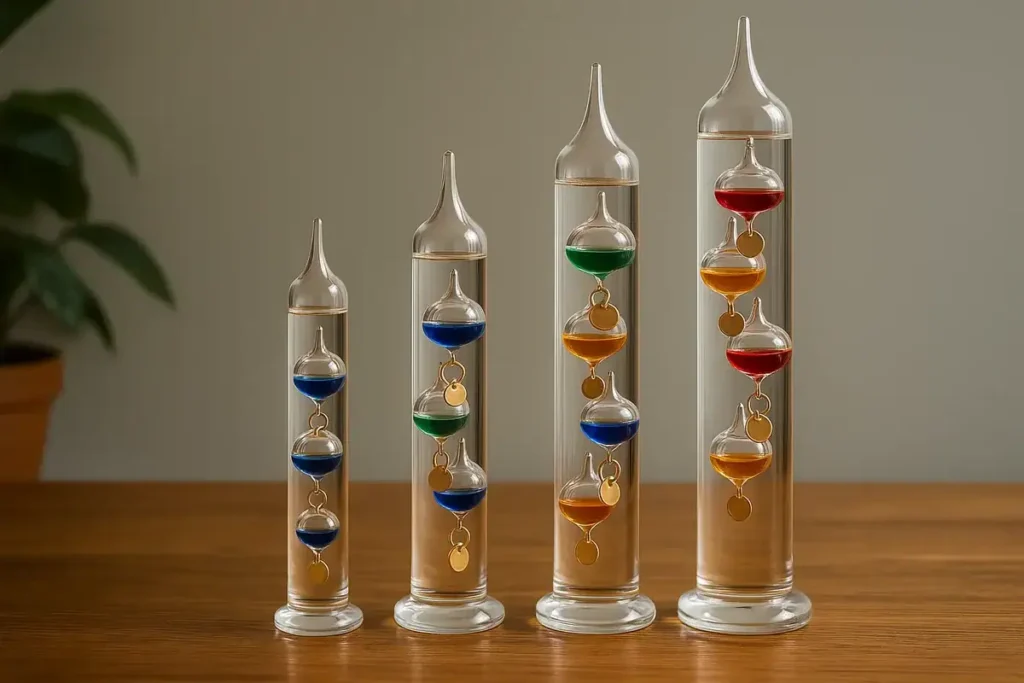
A Galileo thermometer consists of a transparent glass cylinder filled with a liquid (often a colored oil or alcohol) and small blown glass bulbs. Each bulb contains a colored liquid and a small metal disc engraved with a temperature value.
How Does a Galileo Thermometer Actually Work?
Select options
This product has multiple variants. The options may be chosen on the product page
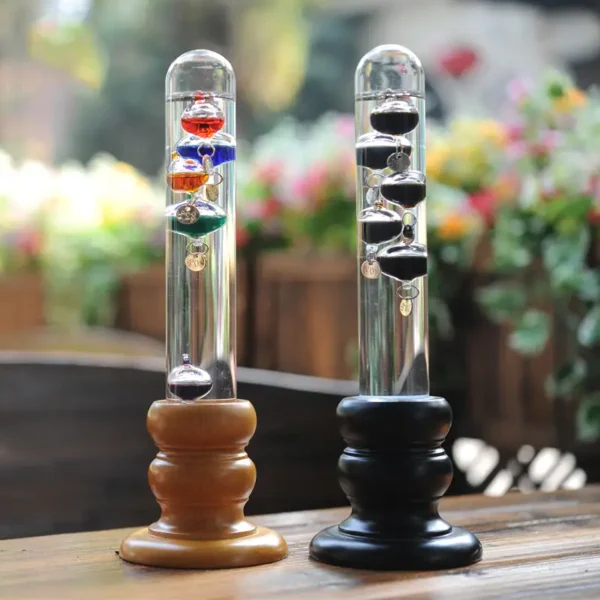
Original Galileo Thermometer
$114.99
Select options
This product has multiple variants. The options may be chosen on the product page
Galileo Glass Thermometer
Price range: $68.99 through $103.99
Select options
This product has multiple variants. The options may be chosen on the product page
Galileo Thermometer Water Drop
Price range: $86.99 through $126.99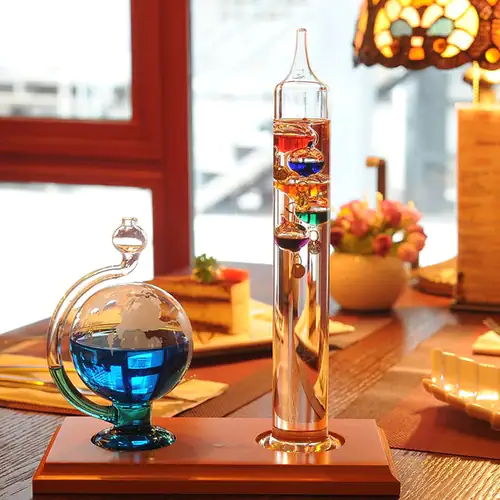
The Role of the Clear Liquid
The cylinder of the Galileo thermometer is filled with a clear liquid, often a colored oil or alcohol. This liquid is chosen for a reason: it has a precise coefficient of expansion that allows it to react significantly to temperature changes. When the room heats up, the molecules of this liquid move faster, take up more space, and the overall density decreases. Conversely, when the temperature drops, the molecules tighten, the volume contracts and the density of the liquid increases. It is this change in density that causes the bulbs to rise or fall. The liquid thus serves as a “sensitive medium,” making visible a physical phenomenon that is invisible to the naked eye.
The Role of the Floating Bulbs and Metal Discs
The colored glass bulbs are not just decorative elements: they are finely calibrated. Each contains a tinted liquid for aesthetic purposes, and a small metal disc bearing a value in degrees Celsius. This disc is not just a visual marker: it adjusts the total mass of the bulb, and thus its density. Therefore, each bulb has a very slightly different density than the others. When the temperature changes, the balance between the buoyant force of Archimedes and the weight of the bulb shifts, causing the floating or sinking of the different spheres. This subtle mechanism transforms an abstract principle of physics into a simple and poetic reading.
How to Read the Displayed Temperature?
Reading a Galileo thermometer may seem mysterious at first glance, but it is actually very intuitive. Simply observe the lowest bulb among those that are still floating. The temperature indicated on its disc corresponds to the closest value to the actual temperature of the room. The bulbs above indicate values that are too low, and those that have sunk correspond to higher temperatures. This system does not allow for precision to the tenth of a degree, but it provides a reliable estimate, generally at ± 1 or 2 °F. It is this simplicity of reading that makes the Galileo thermometer both a pedagogical and decorative object.
Step-by-Step Example of Use
Imagine a thermometer placed in a living room at 72 °F: the bulbs heavier than this value sink, the lighter ones rise, and the lowest among those that float indicates 72 °F.
Precision and Limitations of This Thermometer
The Galileo thermometer is reliable for approximate measurements of indoor temperature, but it is not as precise as a digital thermometer. Its measurement range is limited (typically between 61 °F and 86 °F), making it less suitable for extreme environments.
Applications and Uses of the Galileo Thermometer
It is primarily used as a decorative object in homes or offices. It also has educational value, as it illustrates concepts of physics such as density, buoyancy, or the expansion of liquids.
Comparison: Galileo Thermometer vs Other Types of Thermometers
Here is a comparison table to position the Galileo thermometer relative to other models:
| Thermometer Type | Accuracy | Aesthetics | Measurement Range | Uses |
|---|---|---|---|---|
| Galileo | Moderate | Highly decorative | 61°F – 86°F | Decor, educational |
| Digital | Very high | Not very decorative | -58°F to +302°F | Everyday, professional |
| Mercury (legacy) | High | Classic | -38°F to +673°F | Medical, scientific |
Practical Tips for Using Your Galileo Thermometer Correctly
Place it in a temperate room, away from direct sunlight and drafts. Do not shake it and simply clean it with a soft cloth. A good placement ensures a better reading.
Common Mistakes to Avoid
Many believe it to be a precise scientific measuring instrument: in reality, it is primarily a pedagogical and decorative object. Also, avoid placing it in a kitchen or bathroom where humidity can alter the measurements.
Practical Cases and Expert Advice
In a house, it provides a visually pleasant estimate of the temperature. In class, it can serve as a teaching tool to explain density and Archimedes’ principle. For accurate measurements, it is best to complement it with a digital thermometer.
FAQ: Frequently Asked Questions About the Galileo Thermometer
Why do some bulbs float and others sink?
This depends on the density of the surrounding liquid. When the temperature changes, the liquid becomes more or less dense, causing some bulbs to float or sink.
What is the temperature range measured?
Most models measure between 61 °F and 86 °F. Outside of this range, the indications are not reliable.
Is the Galileo thermometer dangerous if it breaks?
No, there is no mercury. The liquid is usually a colored oil or alcohol. Just avoid skin contact and clean up immediately in case of breakage.
Can it be made at home?
In theory yes, but it requires great precision to calibrate each bulb. It is better to buy a pre-made model to ensure reliable operation.
Conclusion
The Galileo thermometer is a perfect blend of science and aesthetics. It simply illustrates the relationship between density and temperature while adding an elegant touch to an interior. Although it doesn’t replace a precise thermometer, it remains a fascinating tool to spark scientific curiosity and beautify a room.
Also discover our latest article on the operation of a Crookes radiometer.