Free Shipping on Orders Over $50
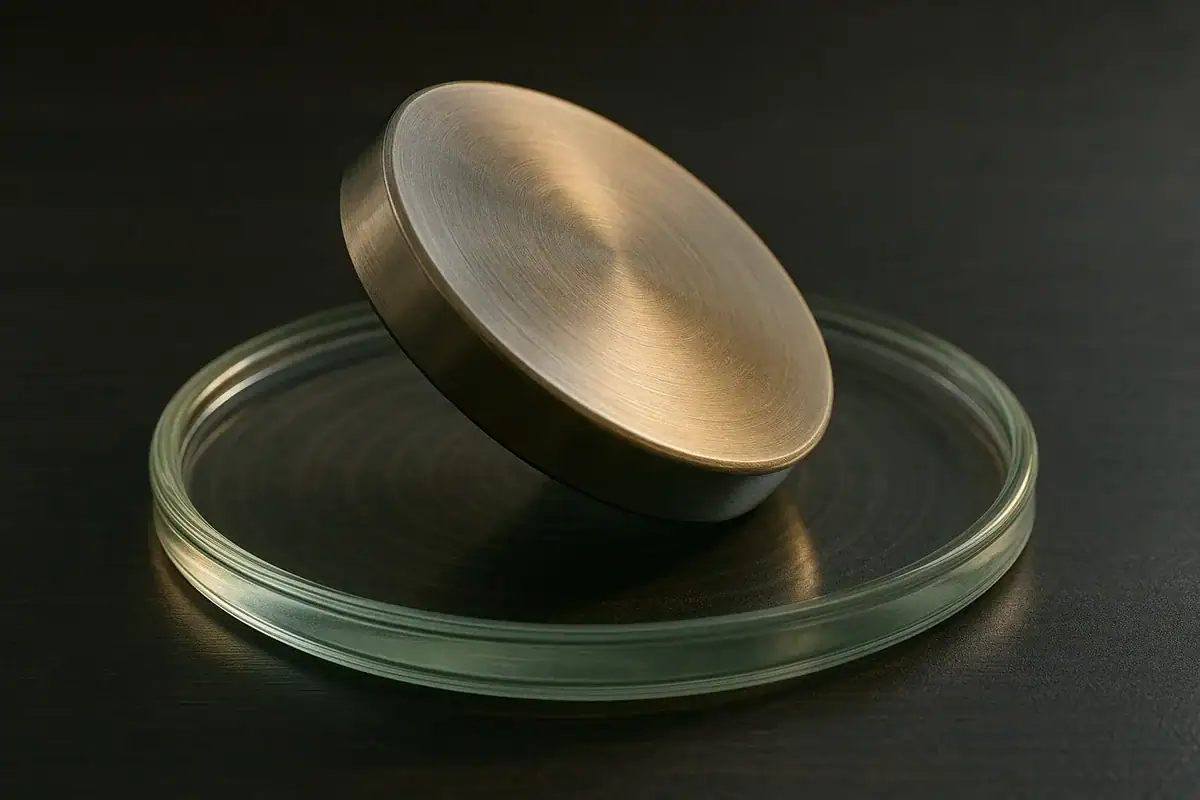
The Euler disk is a scientific object that intrigues both physics enthusiasts and casual observers. When spun on a flat surface, it oscillates and produces a particular sound before suddenly stopping. This phenomenon results from the combined action of gravity, rotation, and friction. In this article, we will look in detail at why this disk spins this way, which physical laws are at play, and how to use it for educational purposes or simply appreciate it as a fascinating experience.
Contenus
afficher
The Basic Principle of the Euler Disk
Definition and Origin of the Experiment
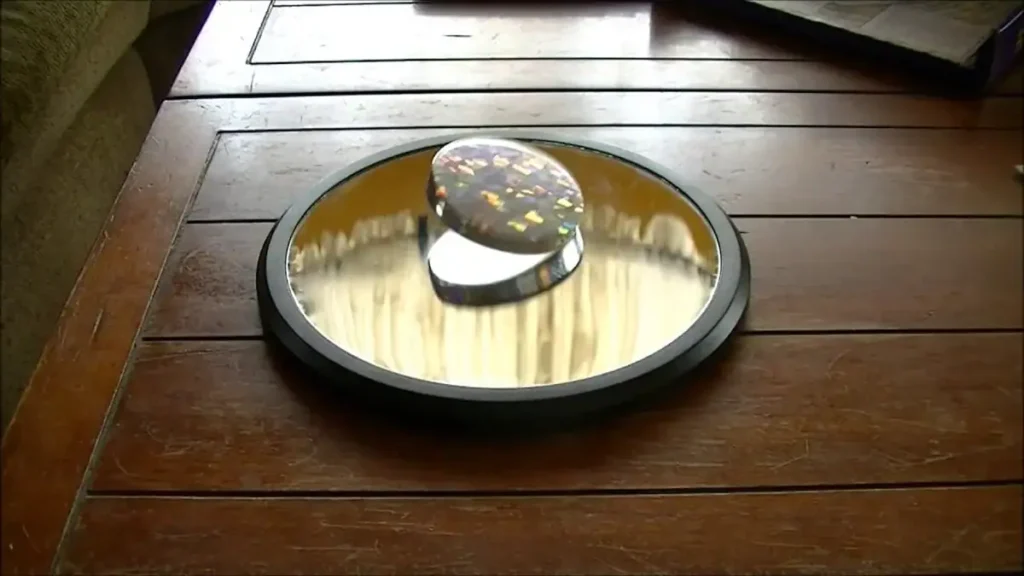
The Euler disk is a physics experiment highlighted in the 1980s by engineer Joseph Bendik, but its name pays tribute to the famous mathematician and physicist Leonhard Euler. The principle is simple: a thick metal disk rests on a concave surface made of glass or metal. When spun, it tips slightly and oscillates while gradually losing energy.
The Physical Laws in Play (Rotation, Energy, Gravity)
The disk illustrates several fundamental concepts:
- Rotation: the disk is launched with a circular motion that creates kinetic momentum.
- Gravity: by tipping slightly, the disk is continuously pulled downward.
- Kinetic Energy: it gradually transforms into heat and vibrations due to friction.
Why Does the Disk Eventually Stop?
Although it sometimes seems to spin indefinitely, the disk always eventually stops because its energy is dissipated. The friction from the air and contact with the surface gradually absorbs the rotational energy until there isn’t enough left to maintain the motion.
The Role of Physical Forces in the Euler Disk
Friction Between the Disk and the Surface
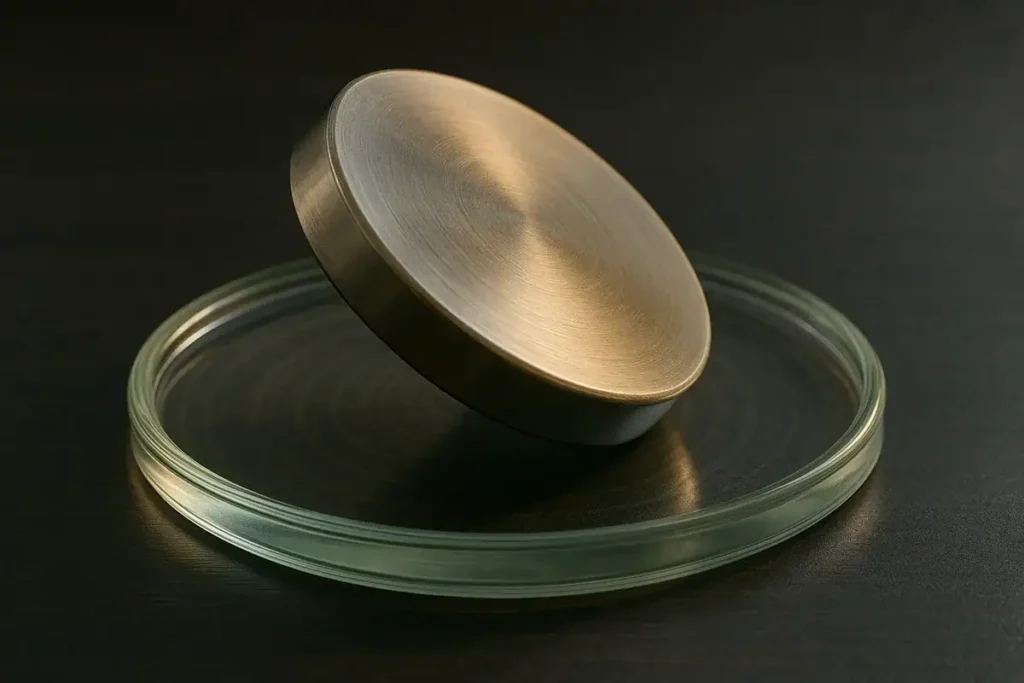
The contact point between the disk and the surface generates significant friction. Even if the surface is perfectly smooth, this friction dissipates energy and slows down the motion.
Energy Loss and Transformation into Heat and Vibrations
Kinetic energy is never destroyed but transformed. In the case of the disk, it converts into heat (imperceptible to the naked eye) and vibrations transmitted to the surface. This is why small tremors are observed as the disk loses speed.
The Sound and Visual Effect of Final Acceleration
One of the notable characteristics of the Euler disk is that the sound accelerates as it nears stopping. This apparent paradox is explained by the decrease in the angle of oscillation: the disk tips faster and faster, reaching a high frequency before abruptly coming to a halt.
How to Properly Use an Euler Disk?
To fully observe the phenomenon, it is advisable to use a stable and concave surface, generally made of glass. A well-measured launch, not too weak or too strong, allows for optimal spinning time (sometimes more than one minute). The flatter and more polished the surface, the more spectacular the experience will be. Some models even include a specially designed base to reduce energy loss.
Scientific and Educational Applications
The Euler disk is not just a curiosity. It is also an educational tool to illustrate energy dissipation and motion dynamics. In an educational context, it allows for discussions about concepts such as friction, moment of inertia, and energy transformation. It is also used in popular science, particularly in museums or interactive exhibitions.
Comparison with Other Scientific Experiments
| Object | Physical Principle | Duration/Observation | Use |
|---|---|---|---|
| Euler's Disk | Rotation, energy dissipation | Several tens of seconds | Physics, education |
| Gyroscope | Angular momentum, precession | Varies depending on initial energy | Navigation, education |
| Radiometer | Radiation pressure | Continuous as long as exposed to light | Optical experiments |
Practical Cases and Expert Tips
How to Explain the Phenomenon to a Child?
A simple explanation is to say that the disk “spends its energy” by rubbing against the surface, much like when you rub your hands together and they get warm. This helps to make the concept concrete and accessible.
Simple Experiment to Do at Home
Simply place an Euler disk on its base and launch it gently. The child can observe the oscillations and hear the changing sound. It is a fun way to spark scientific curiosity.
Use in Scientific Demonstration
In a classroom, the Euler disk can introduce complex concepts like energy conservation, while also captivating attention with its impressive visual and auditory aspects.
Mistakes to Avoid with the Euler Disk
Using an Unstable or Uneven Surface
An improper surface significantly reduces the effect and skews the results. It is therefore better to use a suitable and smooth base.
Applying a Poor Starting Impulse
A launch that is too weak quickly stops the disk, while a launch that is too forceful can cause imbalance. The proper action is to give a firm but controlled impulse.
Confusing it with a Simple Toy
Although it’s playful, the Euler disk is not a classic toy but a true educational tool. Approaching it solely as a distraction prevents one from grasping its scientific value.
FAQ: Frequently Asked Questions About the Euler Disk
Why Does the Disk Seem to Accelerate at the End?
It is not its rotation speed that increases, but its oscillation angle that decreases, giving the impression of sound and visual acceleration.
Are There Different Sizes and Materials of Disks?
Yes, there are models made of steel, aluminum, or glass, in various sizes. Heavier disks tend to spin longer than lighter ones.
Can You Make Your Own Euler Disk?
It is possible to replicate the experiment with a polished metal disk and a concave surface, but commercial models are optimized to provide better performance and longer spinning time.
Conclusion
The Euler disk is a fascinating example of how simple physical laws can produce a spectacular effect. By combining rotation, friction, and gravity, it perfectly illustrates energy dissipation. Whether for learning, teaching, or simply admiring an amazing phenomenon, the Euler disk remains a staple of popular science.