Free Shipping on Orders Over $50


Tensegrity is a fascinating concept that combines tension and compression to create stable, lightweight, and surprisingly resilient structures. It can be found in both modern architecture and the human body. From the very first lines, let’s remember the main point: tensegrity allows for a unique balance that sometimes defies our intuition. In this article, we will explore its origin, principles, practical applications, and implications in science and daily life.
Contenus
afficher
Origins and definition of tensegrity
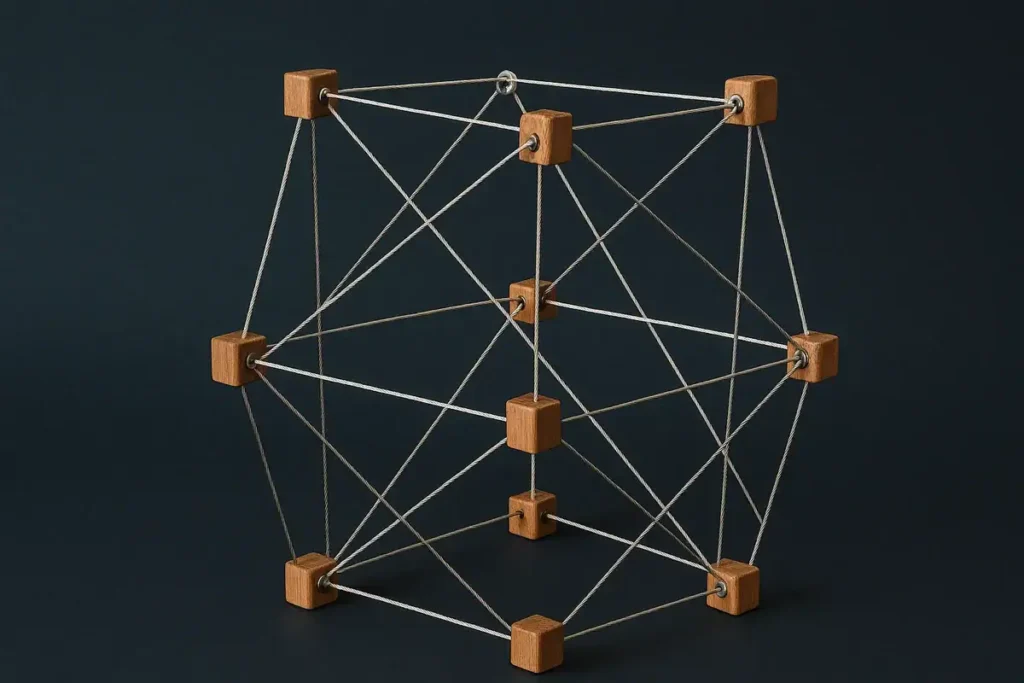
The word tensegrity comes from the contraction of tension and integrity. It refers to a spatial organization where tension cables and compression bars coexist without directly touching, creating a stable and self-supporting form.
The concept was popularized by Buckminster Fuller and Kenneth Snelson in the 1940s. While Fuller sought to create lightweight and resilient habitats, Snelson developed the first visible tensegrity structure, combining art and science.
Today, tensegrity goes beyond architecture to become a universal principle used in engineering, design, robotics, biology, and medicine.
Fundamental principles of tensegrity
Tensegrity is based on a principle that appears simple but has great scientific depth: the balance between tension forces and compression forces. It is this alliance that gives these structures their unique stability and sometimes “magical” appearance.
A balance between tension and compression
Unlike a traditional framework where rigid elements lean on each other, tensegrity works differently:
- Continuous tension: provided by cables, ropes, or strings that wrap around and hold the whole assembly. These flexible elements work continuously and distribute forces in all directions.
- Discontinuous compression: represented by rigid bars (wood, metal, plastic) that never touch directly but are “suspended” by the network of cables. They seem to float in space, but their position is precisely fixed by the surrounding tensions.
This model is comparable to a stretched fishing net: each element takes its place thanks to the others, and the whole remains coherent even if part of it is under stress.
An even distribution of forces
The great strength of tensegrity is that each element contributes to the overall balance. No point bears the entire load: tension diffuses throughout the system. This allows the creation of structures that are:
- Lightweight: a minimum amount of material is enough to construct a stable structure.
- Resilient: the force is evenly distributed, reducing the risk of localized breakage.
- Adaptive: capable of deforming slightly and absorbing shocks or vibrations, then returning to their original state.
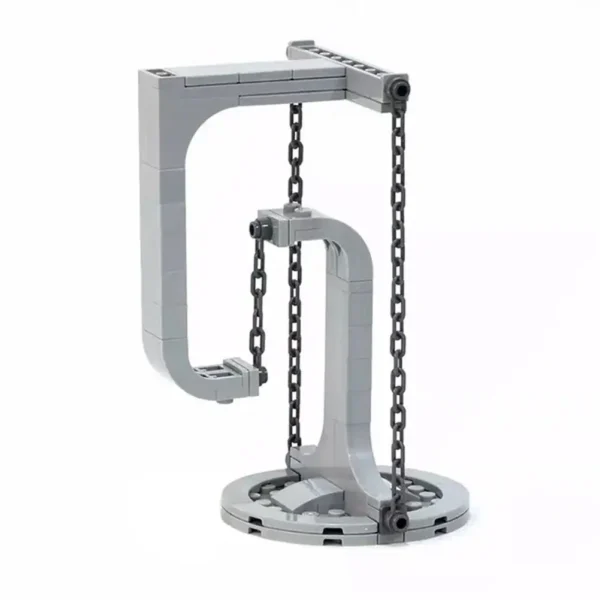
Tensegrity Lego
$14.99A self-supporting and synergistic system
Another fundamental principle of tensegrity is its synergy. No single element can maintain the structure alone: stability comes from the interaction between all parts. It is a self-supporting system, where the whole is greater than the sum of its parts. If a cable or a bar is removed, the entire assembly collapses, proving that the cohesion depends on the total integrity of the system.
A model inspired by nature
Nature massively employs this principle. The cytoskeleton of cells, our bones and soft tissues, as well as spider webs function according to this tension/compression logic. This makes the concept of tensegrity not only useful in engineering but also essential in biology.
In summary, tensegrity is defined by four essential characteristics:
- Omnipresent tension: the flexible network maintains cohesion.
- Isolated compression: rigid elements float without direct contact.
- Fair distribution of stresses: avoiding weak points.
- Resilience: the ability to absorb and redistribute shocks.
Applications of tensegrity in architecture and engineering
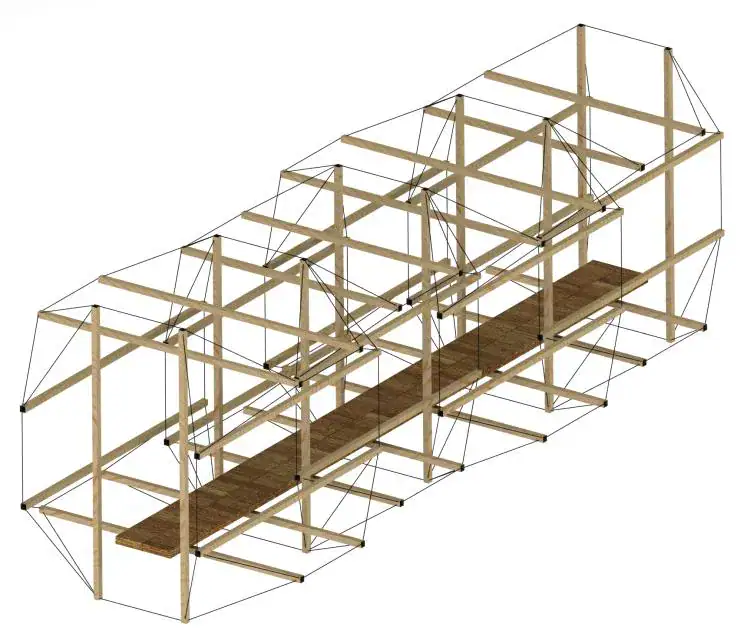
Architects and engineers leverage tensegrity to design innovative constructions:
- Suspension bridges and futuristic walkways, where lightness is a major asset.
- Modular roofs in stadiums or exhibition halls.
- Monumental sculptures that seem to defy gravity.
These applications show that tensegrity is not just a theoretical concept: it is a concrete solution to reduce costs, save materials, and offer unique architectural forms.
Tensegrity in biology and medicine
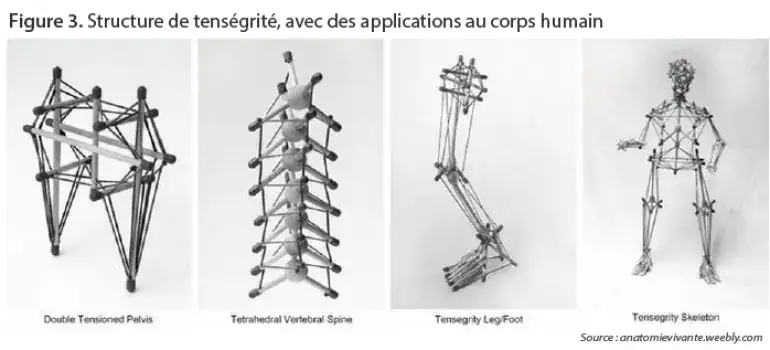
The human body as a tensegrity structure
Our bones, muscles, and fascia interact according to the principle of tensegrity. The bones act as compression bars, while the soft tissues (muscles, ligaments, tendons) provide tension. This model helps to better understand how the body remains stable while being mobile.
Applications in biomechanics and medical research
Tensegrity is used to study:
- The transmission of mechanical forces through cells.
- The mechanisms of healing and tissue regeneration.
- The development of biomimetic prosthetics and implants.
Implications for understanding movement and posture
In physiotherapy and osteopathy, tensegrity is a valuable conceptual tool. It explains how localized tension (for example, in the back) can influence overall posture. This opens the door to holistic approaches to treatment.
Comparative table: tensegrity vs traditional structures
| Criteria | Tensegrity | Traditional Structure |
|---|---|---|
| Weight | Lightweight, requires few materials thanks to force distribution. | Heavy, depends on the mass and density of rigid elements. |
| Stability | Based on a global balance between tension and compression. | Ensured by local rigidity and fixed support points. |
| Flexibility | Highly adaptive, absorbs vibrations and shocks. | Low, risk of failure under unexpected stress. |
| Resilience | High, returns to its shape after deformation. | Limited, deformation often leads to cracks or fractures. |
| Durability | Good if cables are well maintained and protected from wear. | Depends on material strength (concrete, steel, wood), but vulnerable to erosion or corrosion. |
| Design Complexity | Innovative design requiring precise calculations and high accuracy. | Standard plans, easier to implement with conventional methods. |
| Aesthetics | Visually striking, airy and innovative appearance. | Solid and massive look, reassuring but sometimes less creative. |
| Cost | Optimized through material efficiency, but can be more expensive due to technical complexity. | Often high in materials, but construction methods are standardized. |
| Field of Application | Futuristic architecture, design, biomechanics, robotics, education. | Traditional buildings, heavy infrastructure (bridges, roads, high-rises). |
| Natural Inspiration | Found in biology (cytoskeleton, spinal columns, spider webs). | Inspired by gravity and ancestral construction. |
Practical cases and expert advice
To experiment with tensegrity, it is possible to create a homemade model:
- Use wooden dowels to represent the bars.
- Use nylon thread or rubber bands for tension.
- Assemble everything to achieve a floating structure.
These educational models allow for a visual understanding of the principles at work and are used in engineering schools as well as in science outreach workshops.
Mistakes to avoid when studying or applying tensegrity
- Confusing with simple suspension: tensegrity is not a traditional suspended structure.
- Underestimating the importance of calculations: a small error in tensions can destabilize the entire assembly.
- Ignoring precision: each element must be perfectly adjusted to ensure stability.
FAQ: answers to frequently asked questions
Is tensegrity reserved for architects?
No. Although it first found applications in architecture, tensegrity is now of interest in various fields such as medicine, robotics, or even contemporary art.
Can tensegrity be applied in sports or rehabilitation?
Yes. Some physiotherapists and sports coaches use this model to explain muscle chains and optimize posture exercises.
What materials are best suited for tensegrity design?
Steel cables, nylon, rubber bands, and rods made of wood or aluminum are commonly used. The choice depends on the type of structure (artistic, educational, technical).
What are the best natural examples of tensegrity?
Nature is full of examples: the cytoskeleton of cells, spider webs, and the human spine perfectly illustrate this principle.
Conclusion: why tensegrity continues to fascinate
Tensegrity is much more than an architectural concept: it is a universal principle that connects science, art, and life. It demonstrates how the cooperation between opposing forces can generate balance, efficiency, and beauty. From cellular scaffolding to futuristic architecture, tensegrity inspires and continues to push the boundaries of our understanding of the world.