Free Shipping on Orders Over $50

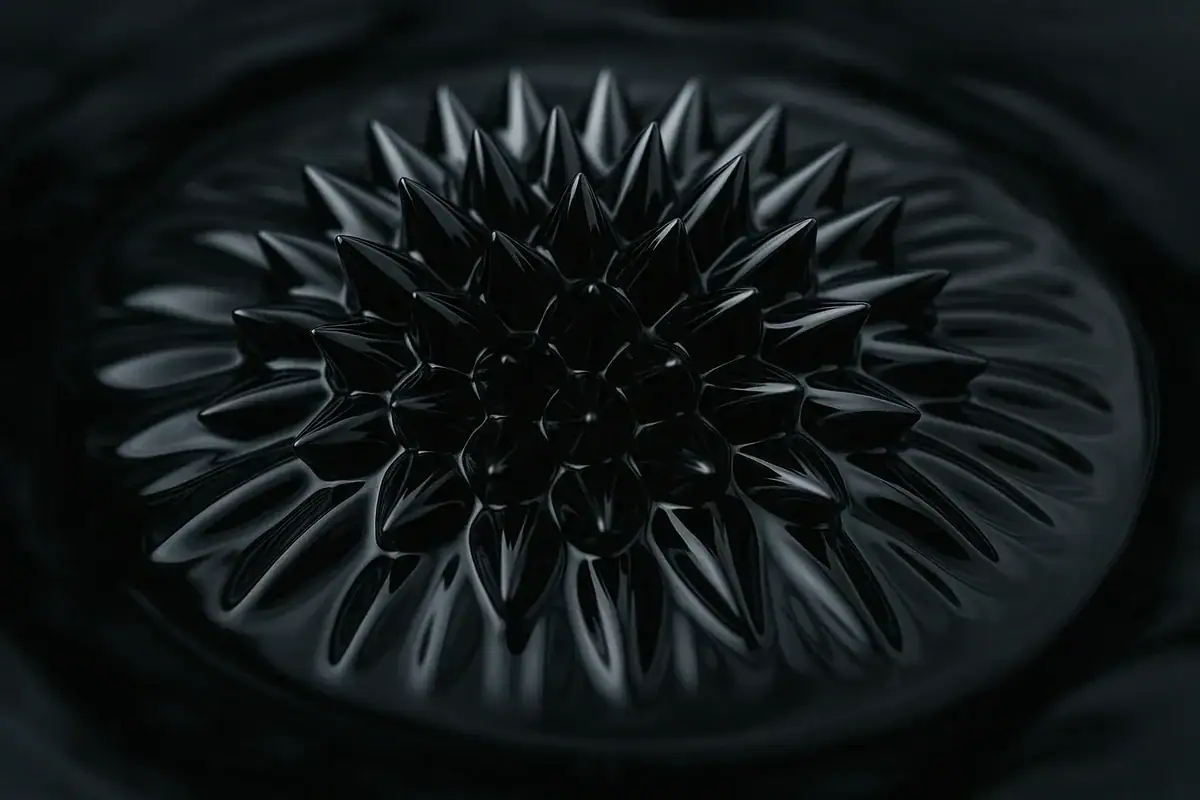
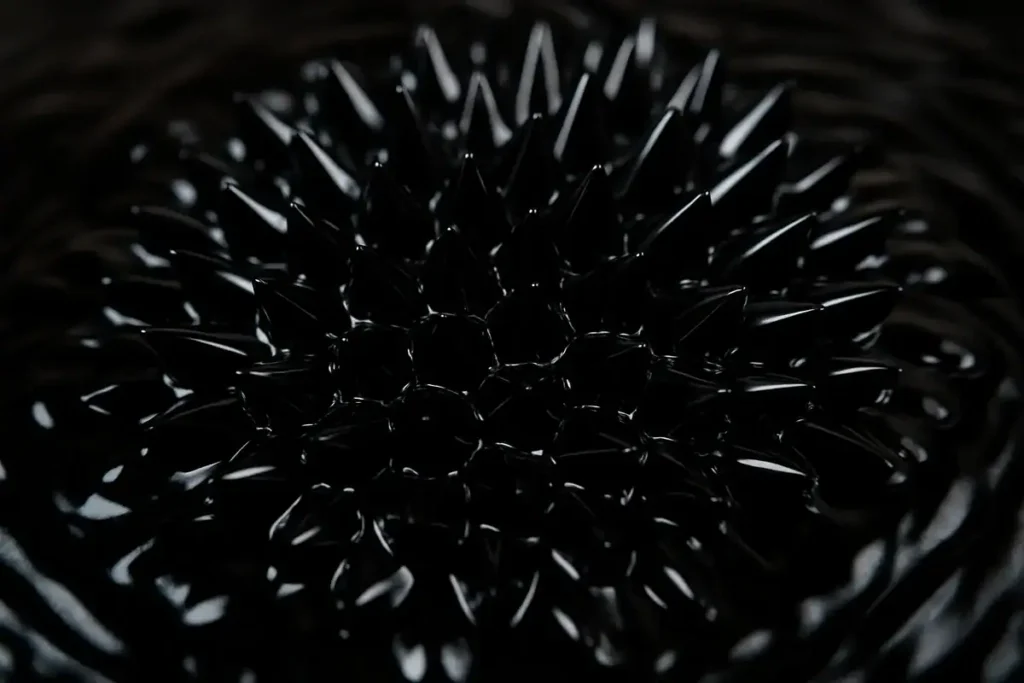
The ferrofluid is a black liquid with a surprising appearance, capable of forming spikes and spectacular patterns in contact with a magnet. It intrigues both scientists and the general public. Specifically, it is a mixture of magnetic nanoparticles and a carrier liquid that reacts to magnetic fields. Let’s discover together what it is, how it works, and its uses, from laboratories to decorative objects.
Contenus
afficher
What is a ferrofluid?

Select options
This product has multiple variants. The options may be chosen on the product page
Music Ferrofluid
$218.99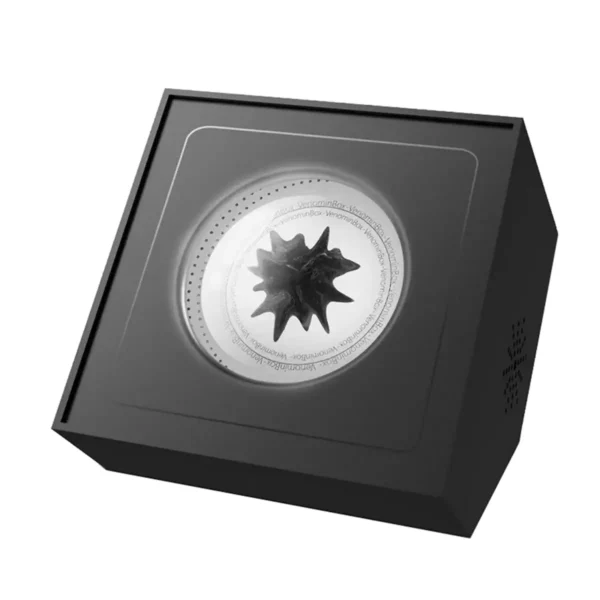
Ferrofluid Decoration
$402.99
Select options
This product has multiple variants. The options may be chosen on the product page
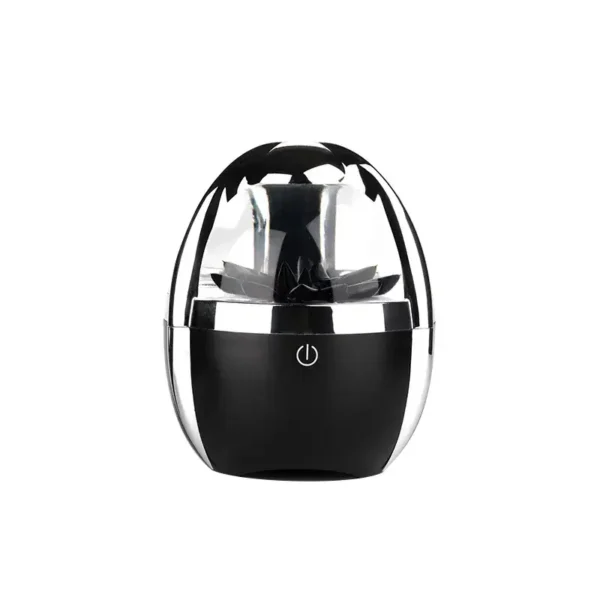
Ferrofluid Lamp
$137.99A ferrofluid is a magnetic fluid composed of tiny particles of magnetite (or iron oxide) suspended in a carrier liquid (water, oil, organic solvent). These particles measure about 10 nanometers, which is a thousand times smaller than a human hair.
Stabilized with surfactants, the mixture remains homogeneous without clumping, allowing the liquid to behave as both a fluid and magnetic material. Discovered in the 1960s by NASA, ferrofluid was initially intended to be used as a magnetizable fuel in space.
How does a ferrofluid work?
The functioning of the ferrofluid relies on a unique combination of magnetism and fluid physics. Each microscopic particle contained in the liquid behaves like a miniature magnet. When the fluid is exposed to a magnetic field, these particles align, which immediately alters its appearance and mechanical properties.
The Role of Magnetic Nanoparticles

A ferrofluid consists of magnetite nanoparticles (iron oxide), measuring about 10 nm. At this scale, their magnetic behavior is particularly intense: each acts as a magnetic dipole, capable of responding to the field lines produced by an external magnet.
Behavior Based on Magnetic Field Intensity
- Without a magnetic field: the fluid remains homogeneous, black, and liquid, like a slightly dense oil.
- With a weak field: small ripples or waves appear on the surface, reflecting the initial organization of the particles.
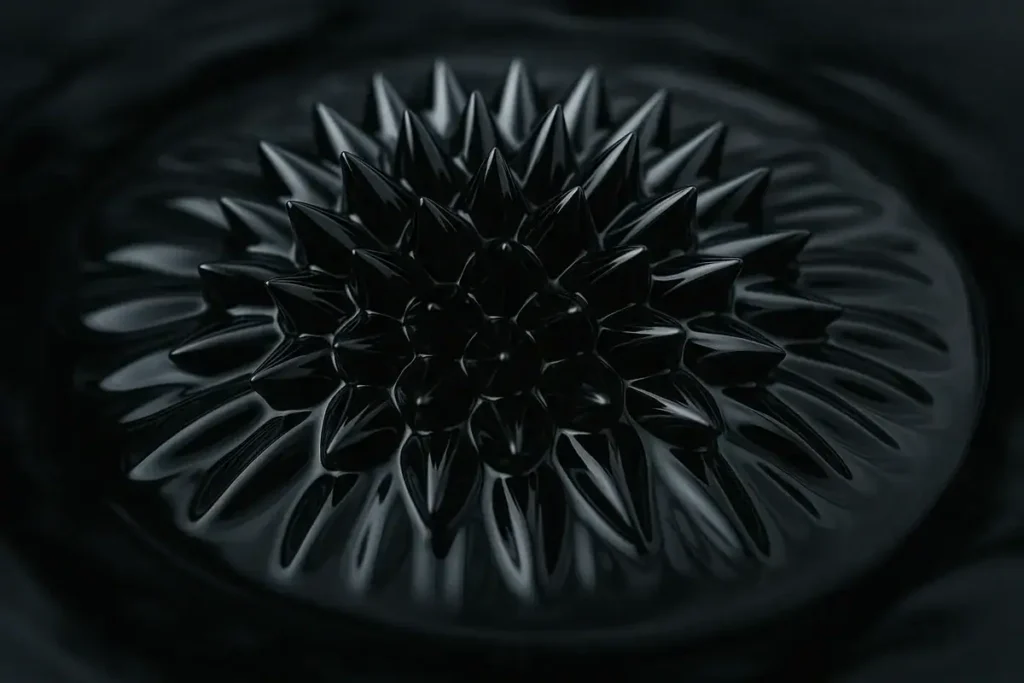
- With a strong field: the famous spiked formations occur. They follow the shape of the field lines, creating a hypnotic visual pattern.
The Physical Phenomena Involved
The spectacular behavior of ferrofluid is related to several principles:
- Magnetism: direct interaction of particles with the applied field.
- Surface tension: the liquid maintains its cohesion, resulting in the formation of sharp crests.
- Hydrodynamics: the way the fluid flows influences the distribution of particles.
- Rosensweig instability: phenomenon that explains the regular formation of spikes under a magnetic field.
A Balance Between Fluidity and Rigidity
The ferrofluid has the unique characteristic of being both fluid and structural. As long as the field is applied, the fluid locally stiffens, forming stable structures. Once the magnet is removed, it instantly returns to its uniform liquid state. This reversible nature is what makes it so fascinating to observe and use.
Advantages and Limitations of Ferrofluid
Advantages of Ferrofluid
The ferrofluid attracts both researchers and enthusiasts with several remarkable benefits:
- A unique visual effect: the spikes and shapes it generates under the influence of a magnet provide a hypnotic and unmatched spectacle.
- Versatility of uses: from scientific research to decoration, it adapts to a variety of contexts.
- A powerful educational tool: it simplifies the explanation of complex concepts such as surface tension, magnetism, or Rosensweig instability.
- Scientific innovation: its magnetic properties open up possibilities in medicine (targeting drugs), engineering, and electronics.
- An interactive experience: it reacts instantly to manipulations, making it a captivating object for learning and popularizing science.
Limitations and Constraints of Ferrofluid
Despite its qualities, ferrofluid also presents constraints that are important to know before handling it:
- Persistent stains: its oily aspect and high magnetic particle content make it difficult to clean. A drop can permanently mark fabric or furniture.
- Delicate handling: it requires gloves, pipettes, or suitable containers to avoid accidents and contamination of surfaces.
- Limited lifespan: if not stored properly (exposed to heat or air), it can dry out, separate, or lose its fluidity.
- Irritation risks: although non-toxic in regular use, prolonged contact with skin may be irritating. It should not be ingested.
- Relative cost: while relatively affordable, it remains more expensive than a simple decorative object like a Newton’s cradle or plasma lamp.
Comparison Table: Ferrofluid vs Other Decorative Scientific Objects
To better position ferrofluid, here is a comparison with other popular scientific objects:
| Object | Scientific Principle | Educational Value | Precautions | Average Price |
|---|---|---|---|---|
| Ferrofluid | Magnetic nanoparticles in suspension | Magnetism, fluid physics, Rosensweig instability | Handle with magnets, avoid direct contact and stains | $20–50 |
| Plasma Lamp | Gas ionization through high voltage | Electricity, plasma, conduction | Do not touch with metal objects, avoid electrical overload | $20–40 |
| Newton's Cradle | Conservation of energy and momentum | Classical mechanics, kinetic energy | None, safe for all audiences | $15–30 |
Practical Cases and Expert Advice
How to Present Ferrofluid in Class or Workshop
Use a small transparent container and a moderately powerful magnet. Show the difference between absence and presence of the magnetic field. This immediately captures students’ attention.
Tips for Creating a Spectacular Visual Effect
- Use a neodymium magnet to achieve well-defined spikes.
- Illuminate the ferrofluid with an LED light to enhance the metallic reflections.
- Vary the distance between the magnet and the container to demonstrate different effects.
Examples of Fun Experiments to Test
- Move a light metallic object using ferrofluid.
- Compare the reaction with various magnets (weak, medium, strong).
- Observe the speed of return to liquid state once the magnet is removed.
Mistakes to Avoid with Ferrofluid
Do Not Use Too Powerful Magnets
This can suck the ferrofluid out of the container and cause splashes that are difficult to clean.
Avoid Direct Contact with Skin or Textiles
The liquid is extremely staining and may contain irritating substances. Always handle it with care.
Do Not Expose to Heat Sources
High temperatures can alter the stability of nanoparticles and render the fluid unusable.
FAQ: Answers to Frequently Asked Questions
Is Ferrofluid Dangerous?
No, it is not dangerous if handled correctly. The main risks involve stains and possible irritation with direct contact. It should not be ingested.
Can Ferrofluid Be Made at Home?
Tutorials exist, but the necessary chemicals (magnetite, surfactants) are difficult to obtain and require a suitable lab. It is better to buy it ready-made.
Where Can You Buy Quality Ferrofluid?
It can be found on specialized scientific objects sites, in some educational shops, or on well-known online platforms.
Does Ferrofluid Lose Its Properties Over Time?
Yes, especially if poorly stored. It should be kept in an airtight container, away from heat and direct light.
Conclusion
The ferrofluid is much more than just a black liquid: it is a fascinating material at the crossroads of science and art. From NASA to classrooms, it inspires researchers, teachers, and enthusiasts of scientific curiosities. When handled with care, it offers a unique experience to understand magnetism while mesmerizing with its hypnotic shapes.