Free Shipping on Orders Over $50

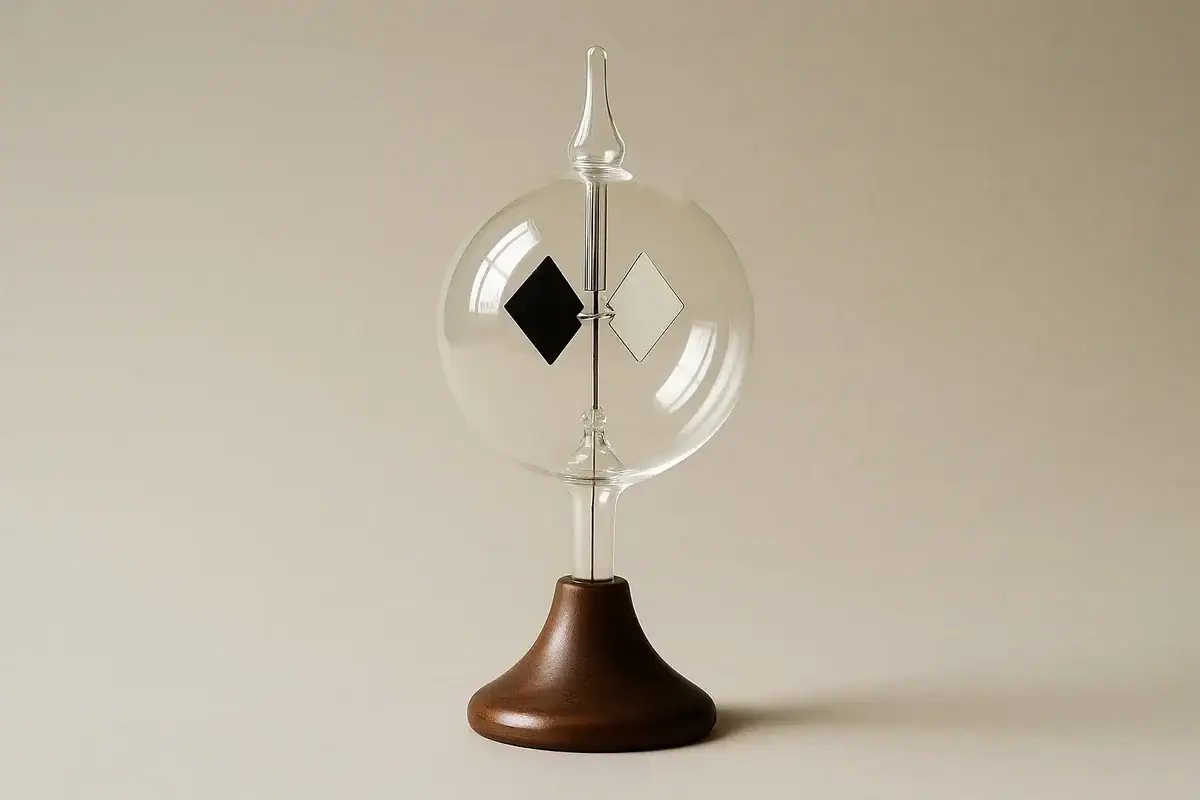
The Crookes radiometer is a fascinating scientific instrument: a simple glass bulb with black and white vanes that start to spin under the effect of light. Contrary to popular belief, it is not the pressure of photons that makes it spin, but a subtle thermal effect related to the partial vacuum inside. Used both as a physics demonstration and as a decorative object, it attracts both enthusiasts and the curious. Let’s explore its history, how it works, and simple experiments to perform.
Contenus
afficher
- What is it? A mini glass instrument where black/white vanes spin in the light.
- Why does it spin? Thermal effect (thermal transpiration in a rarefied gas), not pure radiation pressure.
- What is it used for? A visual demonstration of light → motion conversion, decorative and educational object.
- For whom? The curious, teachers, parents, physics enthusiasts, and lovers of scientific objects.
Definition & Anatomy
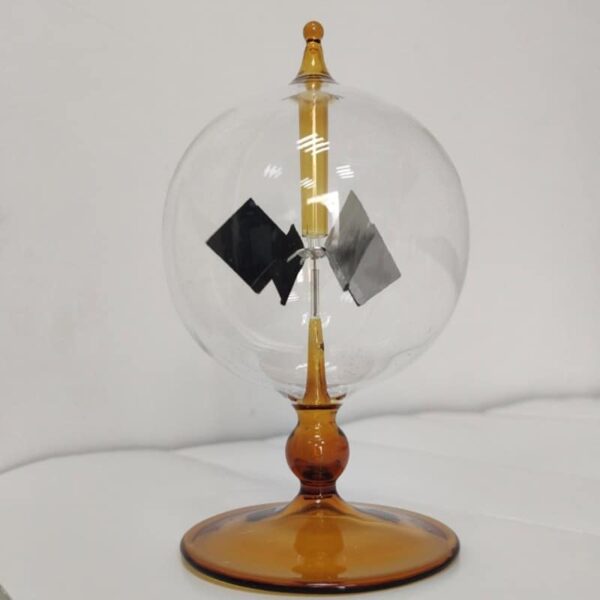
Select options
This product has multiple variants. The options may be chosen on the product page
Crookes Radiometer Design
$51.99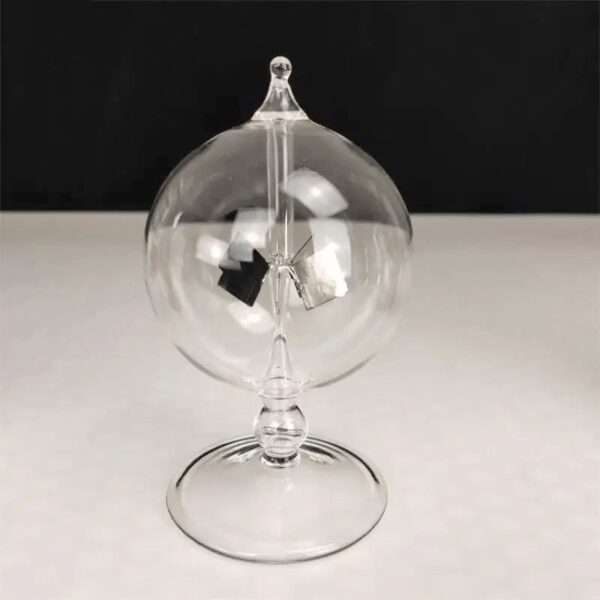
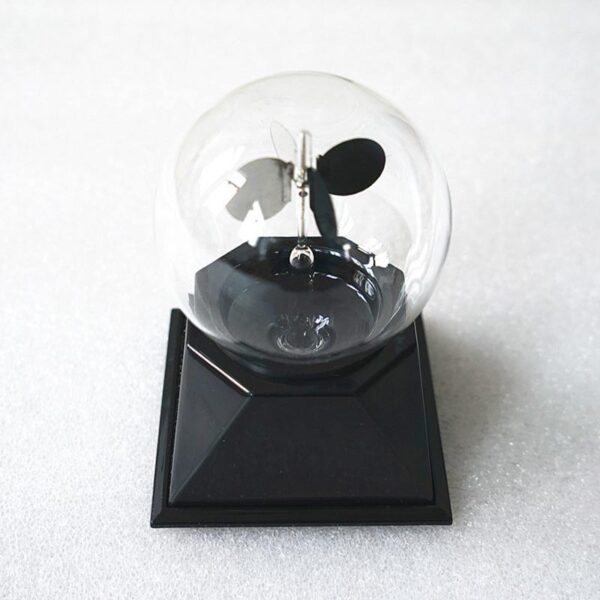
Solar Radiometer
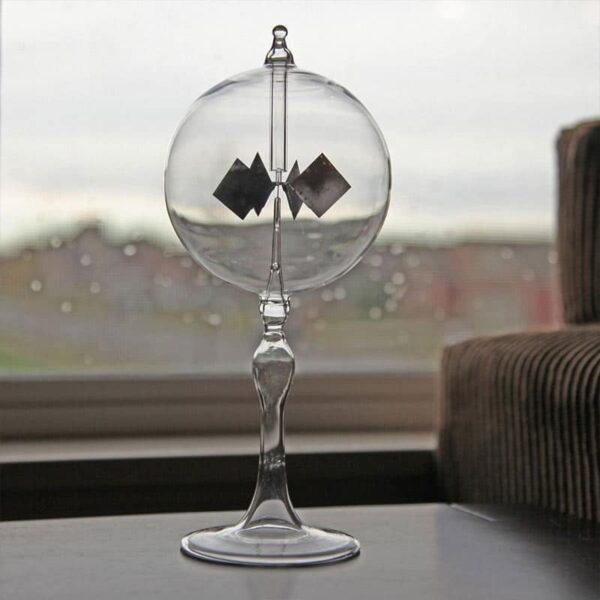
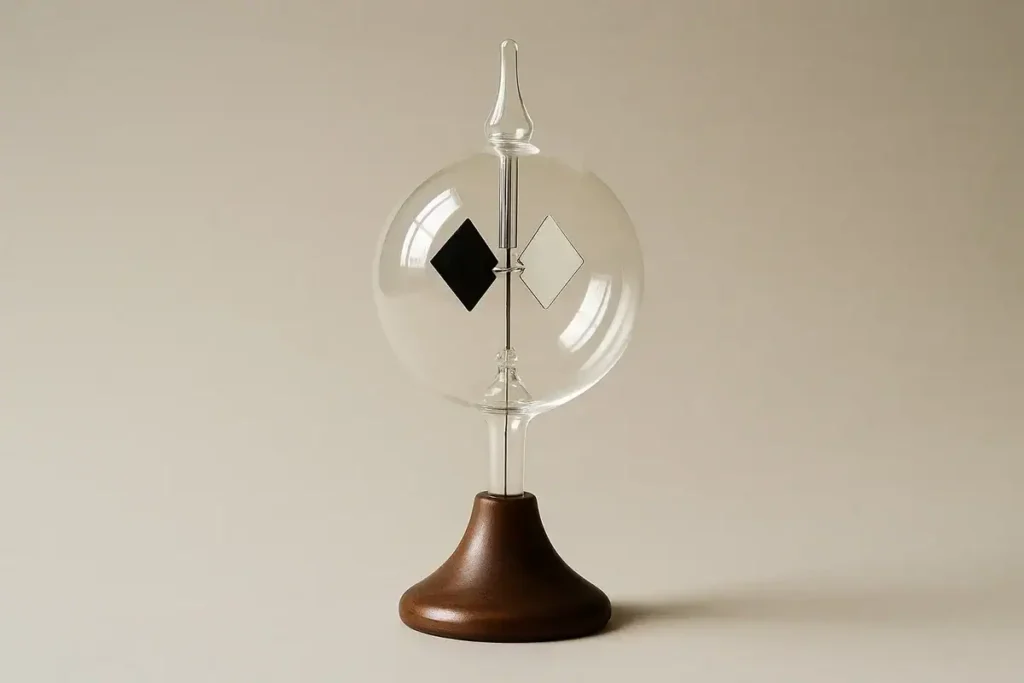
$45.99A Crookes radiometer consists of a sealed bulb containing a partial vacuum. Inside, a rotor is mounted on a nearly frictionless pivot. This rotor has four vanes, one side black and the other white. When light illuminates the instrument, the vanes start to spin.
Mental diagram: bulb → rod → rotor with vanes → support/pivot.
Variants: Various models exist depending on the size of the bulb, the finish of the glass (clear or smoked), and the material of the base (wood, metal).
A Bit of History
Invented between 1873 and 1879 by William Crookes, the radiometer was initially interpreted as proof of the radiation pressure predicted by Maxwell’s electromagnetic theory. But soon, scientific debates arose.
The experiments of Reynolds, Knudsen, and even Einstein showed that the correct explanation lay in the thermal transpiration of a rarefied gas, a phenomenon still little understood at the time.
The Physics Behind the Magic ✨
Operating Conditions
- Partial vacuum: essential to allow asymmetric molecular collisions.
- Energy source: sunlight, incandescent lamp, infrared radiation, or any heat source.
Main Mechanism (currently accepted)
The black side absorbs more light and heats up more than the white side. This difference creates a temperature gradient along the edges of the vanes. The gas molecules, interacting with these areas, generate a force called thermal transpiration, which causes the rotor to spin.
The rotation stops when the temperatures equalize and the pivot friction dissipates the energy.
Common Misconceptions to Correct
- Myth: “It’s the light that pushes the vanes” → false in this context.
- True: Radiation pressure exists but its effect is negligible compared to thermal forces.
Simple Experiments to Perform (Safety & Step-by-Step)
1) Light Intensity Curve → Speed
Place a lamp at different distances and measure the number of revolutions per minute. Compare with direct exposure to sunlight.
2) Color Filter
Use red, blue, green filters: each color is absorbed differently, which alters the speed of rotation.
3) Hot Source Effect
Place a halogen lamp or an infrared source. The vanes will react even without strong visible light.
4) Cast Shadow
Cover part of the vanes: you will observe a decrease, or even an inversion of speed.
5) Ambient Temperature & Convection
Test in a cold or hot chamber. Be careful to isolate from drafts, which can skew the experiment.
⚠️ Safety note: Always handle by the base. Do not place the bulb in direct sunlight and then in a cold environment (risk of cracking). Do not let children under 6 handle the object.
Applications & Educational Interest
The radiometer offers a unique visualization: it makes visible the transformation of light energy into mechanical motion, a fascinating experience that immediately captures attention.
Beyond its spectacular aspect, it serves as a concrete support for addressing often abstract concepts such as thermal transfer, the behavior of rarefied gases, and temperature gradients.
Whether used during class demonstrations, displayed in a science museum, or simply placed as a decorative object, it is also an ideal STEM gift to stimulate curiosity and a desire to explore science.
Frequently Asked Questions (FAQ)
Why are the black vanes on the “driven” side?
Because the black side absorbs more heat, creating a thermal flow that pushes the vane forward.
Does it work with cold light (LED)?
Yes, but the rotation is weaker because LEDs emit little infrared, resulting in less heating.
Can it be opened or the vacuum recharged?
No, the bulb is hermetically sealed. If the vacuum degrades, the object becomes less responsive.
Is it dangerous in direct sunlight?
No, but avoid prolonged exposure: the glass can overheat and crack.
How long does it last?
A quality radiometer can last several decades, as long as the bulb remains intact.
The Crookes radiometer is not just a beautiful object; it is a true lesson in physics condensed into a bulb. Whether to awaken children’s curiosity, illustrate thermodynamic laws in class, or simply decorate a desk, it remains a timeless instrument that connects science and aesthetics.