Free Shipping on Orders Over $50

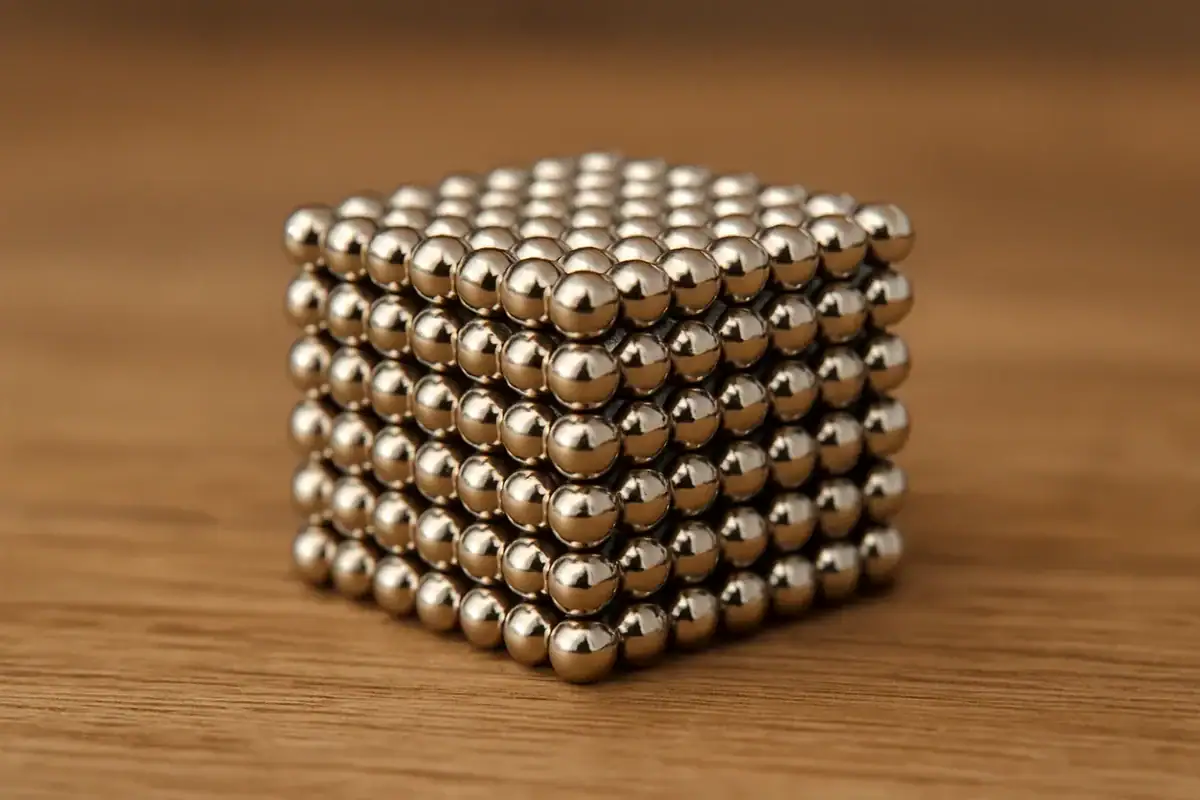
The magnetic balls are small magnetic spheres capable of assembling into an infinite number of shapes. Very popular among teenagers and adults, they are used to create constructions, relax, or explore magnetism. But be careful: handling them requires vigilance, especially in the presence of children. In this comprehensive guide, discover how to use them safely, the possible creations, and the mistakes to avoid.
Contenus
afficher
What is a magnetic ball?
A magnetic ball is a small metallic sphere with a magnetic core, usually made of neodymium, a material recognized for its strength and durability. Their diameter often ranges between 0.12 and 0.24 Inch, allowing manipulation of many balls at once to create various assemblies. Thanks to their north and south poles, they attract and repel each other depending on their orientation, opening the door to an infinite number of combinations in 2D and 3D.
These balls are found under different commercial names: neocubes, magnetic balls, or magnetic spheres. They attract a wide audience, from teenagers to adults, as they combine creativity, relaxation, and scientific learning.
Their appeal is based on several complementary aspects:
- A creative and recreational side: they allow you to build simple or complex geometric shapes, experiment with symmetry, and imagine unique decorative structures.
- An anti-stress effect: like fidget toys, they help channel energy, reduce nervousness, and improve concentration.
- An educational role: they serve as a concrete support for understanding the principles of magnetism, geometry, and even spatial logic.
Somewhere between a desk toy, an educational tool, and a decorative scientific object, magnetic balls are gaining increasing popularity, while requiring careful use, especially in the presence of children.
What to do with magnetic balls?
Ideas for geometric and creative constructions
A simple set of 216 magnetic balls offers a multitude of possibilities. These small magnetic spheres are designed to be assembled and disassembled endlessly, opening the door to limitless creativity. Among the most popular ideas:
- Flat polygons: triangles, squares, pentagons, hexagons, or even stars, perfect for beginners to understand magnetism.
- 3D shapes: cubes, pyramids, balls, or more complex polyhedra that require logic and patience.
- Decorative objects: initials, hearts, spirals, or even stylized figurines like animals or symbols.
- Modular structures: assemble several small modules (squares or triangles) to create larger and more impressive constructions.
These creations are both playful and aesthetic: they can decorate a desk, become a challenge among friends, or a tool to develop one’s sense of symmetry.
Using as an anti-stress and concentration tool
In addition to the creative aspect, magnetic balls are used as a stress-relief object. Their handling is reminiscent of a fidget toy: rolling the balls between your fingers, attracting and repelling them provides a soothing sensation. This allows you to:
- Channel your energy during a meeting or intense intellectual work.
- Reduce anxiety through repetitive and relaxing gestures.
- Improve concentration, especially for those who need to manipulate something to stay attentive.
Many users report that these balls are an excellent support for active meditation or a tool to combat boredom during repetitive tasks.
Educational applications for understanding magnetism
Beyond play and relaxation, magnetic balls are also an ideal educational tool for explaining scientific concepts:
- Attraction and repulsion: by manipulating two balls, one intuitively understands the north and south poles of magnets.
- Stable and unstable structures: some figures hold easily, while others collapse, illustrating the notion of balance and geometry.
- Applied physics: they allow for discussing topics like magnetic force, potential energy, and the logic of assemblies.
In an educational setting, they are perfect for demystifying science and making physics classes more interactive and tangible.
Comparison table: magnetic balls vs other magnetic objects
To well frame the interest of magnetic balls, here is a comparison with other playful and scientific objects based on magnetism:
| Object | Principle | Advantages | Disadvantages | Average Price |
|---|---|---|---|---|
| Magnetic Balls | Neodymium spheres | Creativity, stress relief, variety of shapes | Ingestion risk, fragility | $15–40 |
| Magnetic Cube | Assembly of cubic magnets | Compact, many combinations | Easy to lose pieces | $10–30 |
| Ferrofluid | Magnetic liquid | Unique visual effect, spectacular | Stains, delicate handling | $20–50 |
Magnetic balls stand out for their versatility: they combine the decorative aspect, creativity, and relaxation, whereas ferrofluid remains mainly visual and a magnetic cube is limited in variety of shapes.
What to do if a child has swallowed magnetic balls?
⚠️ The ingestion of magnetic balls is a medical emergency. These small spheres do not behave like ordinary objects: they can attract each other through the intestinal walls. When they stick together in the digestive tract, they exert continuous pressure that can cause perforations, blockages, or severe infections. The danger lies not only in mechanical blockage but also in the magnetic strength that exacerbates the lesions. That’s why any suspicion of ingestion must be taken very seriously and treated promptly.
🚨 Signs to watch for: persistent abdominal pain, nausea, repeated vomiting, or fever. Sometimes, the symptoms are more subtle: unusual digestive discomfort, absence of bowel movements, or unexplained restlessness. In any case, never wait for the situation to worsen before taking action.
🩺 Immediate actions to take: do not attempt to make the child vomit, and do not try to “pass” the balls by giving him or her something to drink or eat. The only appropriate response is to contact emergency services immediately or a poison control center. Doctors will perform an X-ray to locate the balls and decide on the best intervention. In the most severe cases, surgery may be necessary to prevent irreversible complications.
⏱ When to seek emergency care: the answer is simple: as soon as ingestion is suspected, even in the absence of visible symptoms. Two magnetic balls attracted through the intestine can cause irreparable damage in just a few hours. Waiting puts the child’s health in danger. Vigilance and quick action are the only guarantees to avoid dramatic consequences.
Practical cases, tips, and mistakes to avoid
Magnetic balls are fascinating objects, sources of creativity and relaxation. But to fully enjoy them, they must be used with caution. The most important rule is to never leave them within reach of young children. They should be handled in a clear space, away from computers, phones, or sensitive electronic devices that could be disturbed by their magnetic field.
Playfully, they are ideal for teenagers and adults. Some enjoy recreating famous shapes like the Eiffel Tower or a stylized Rubik’s cube. Others create symmetrical decorative patterns or challenge each other in timed group quests. These activities foster concentration, develop logic, and provide true creative satisfaction.
💡 Expert tip: to extend the life of the balls, store them in an airtight box or on a magnetic base. This prevents them from getting lost and helps avoid corrosion. Always keep them in a dry, temperate place, out of reach of children and pets.
Finally, there are some mistakes that should absolutely be avoided. Leaving the balls accessible to younger children is the number one danger. Forcing the magnets, crushing them, or trying to twist them weakens their surface and diminishes their magnetism. Using them in a humid or hot environment can also damage their protective coating. Responsible use ensures not only safety but also lasting enjoyment.