Free Shipping on Orders Over $50

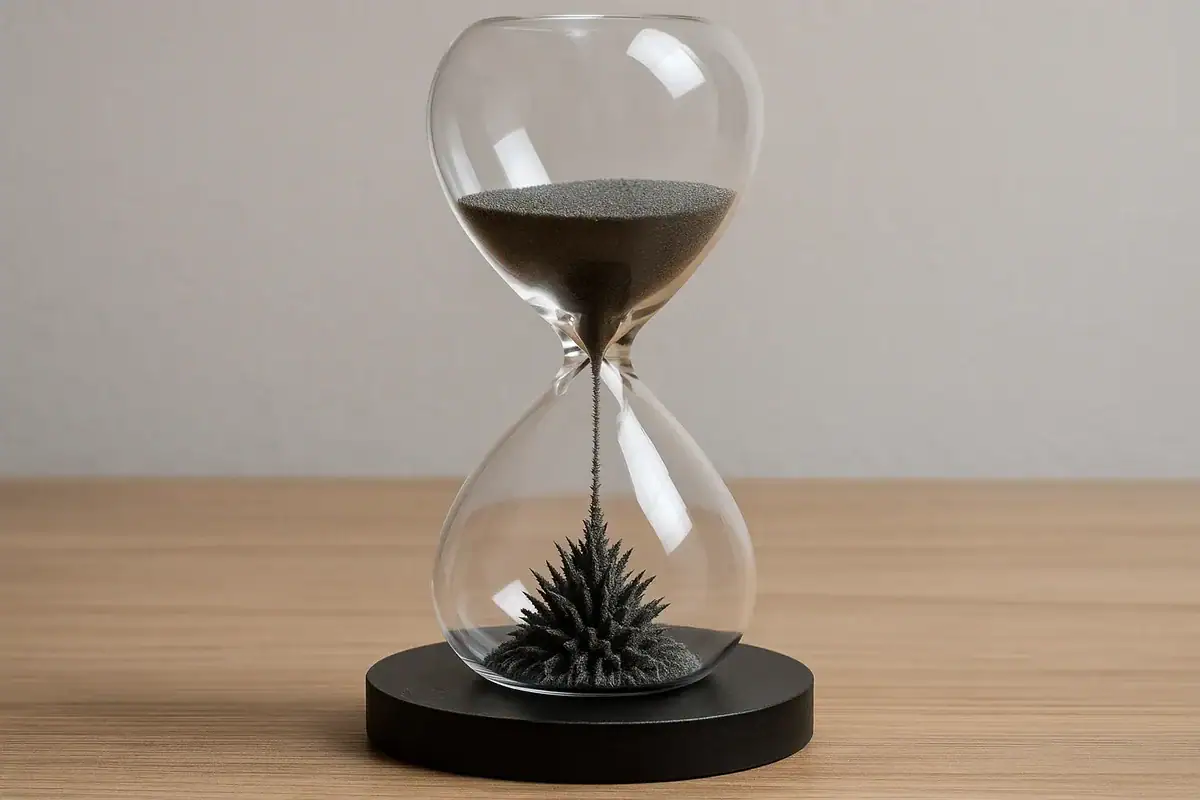
The magnetic hourglass is not just a decorative object: it demonstrates in real time how a magnetic field acts on ferrous sand. In short: gravity makes the grains fall, the magnet at the base attracts them and sculpts them into peaks.
Contenus
afficher
Below: definition, components, principle, steps, uses, comparison, limitations/maintenance, and FAQ.
What is a magnetic hourglass?
Select options
This product has multiple variants. The options may be chosen on the product page
Magnetic Glass Hourglass
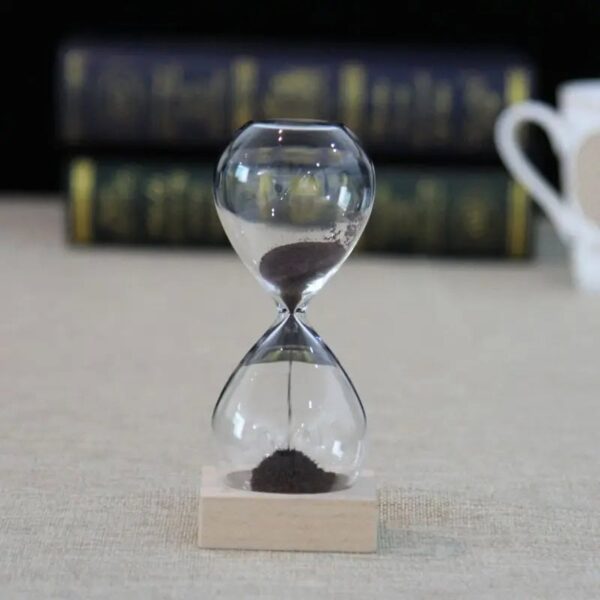
$44.99A magnetic hourglass visually resembles a classic hourglass, but instead of ordinary sand, it contains ferrous powder (fine metallic shavings) and hides a powerful magnet in its base. This combination transforms a simple flow into a genuine scientific and aesthetic experience.
Key difference: the traditional hourglass operates only on gravity, which causes the grains to fall and form a conical pile. The magnetic hourglass adds the force of a magnetic field, which attracts and structures the particles. The result is a surprising balance between order and chaos.
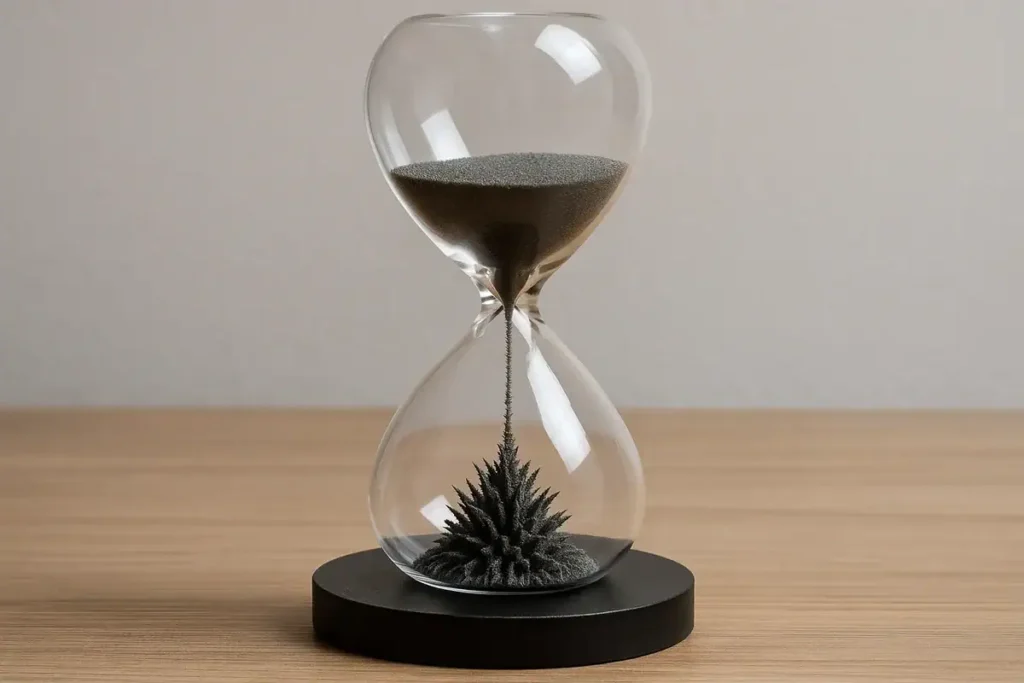
Decorative aspect: with each turn, the ferrous sand does not simply pile up: it organizes into unique shapes – slender peaks, small towers, irregular ridges – reminiscent of miniature stalagmites. No cycle is identical, making it a living and fascinating object to observe.
Educational interest: in addition to its decorative effect, the magnetic hourglass allows you to visualize an invisible force concretely. It is an excellent tool for explaining the difference between gravity and magnetism, and for introducing both young and old to the mysteries of magnetic fields.
The components of a magnetic hourglass
- The ferrous sand: grains containing iron particles/iron oxides, sensitive to the magnetic field.
- The magnet: usually housed in the base; it creates the field that attracts and orients the particles.
- The glass: protects and allows observation of the formation of structures.
Mental image: a fine stream of sand falls… but instead of a conical pile, a small “forest” of metallic peaks appears.
The scientific principle behind the magnetic hourglass
Two forces add up:
- Gravity pulls the grains downward.
- The magnetic field of the magnet attracts and aligns the ferrous particles.
Their combination causes the aggregation of the grains into sharp structures instead of just a simple pile. In layman’s terms: in a classic hourglass, the grains slide and stack; here, they “cling” to each other under the influence of the magnet.
Steps of operation
- Fall by gravity: the sand flows through the central opening.
- Magnetic capture: at the bottom, the magnet immediately attracts the ferrous grains.
- Organization: the particles align and form peaks, towers, and ridges.
- Variability: each turn creates a different sculpture (flow speed, amount of sand, strength of the magnet).
The applications and benefits of a magnetic hourglass
Decorative and original object
A simple piece that catches the eye, perfect for a desk, shelf, or coffee table. Every “creation” is ephemeral and unique.
Educational tool to illustrate invisible forces
Perfect for popularizing magnetism and gravity: the phenomenon becomes visible without formulas.
Scientific and playful gift
Half-experience, half-art object, it’s a gift that appeals to the curious, teachers, makers, and science enthusiasts.
Comparison: classic hourglass vs magnetic hourglass
| Criteria | Classic Hourglass | Magnetic Hourglass |
|---|---|---|
| Function | Timekeeping | Physics demonstration + decor |
| Duration | Calibrated (1, 3, 5 min…) | Fast, rarely calibrated (20–50s) |
| Aesthetics | Regular conical pile | Spikes, ridges, random shapes |
| Scientific Interest | Gravity | Gravity + magnetism |
| Uses | Practical timer | Curiosity piece, decor, educational tool |
Limitations and maintenance of the magnetic hourglass
- Uncertain duration: not ideal as an exact timer.
- Fragility: glass should be handled with care.
Advice: avoid shocks and humidity, keep away from devices sensitive to magnetic fields, do not open, do not shake excessively.
FAQ about magnetic hourglasses
How long does a magnetic hourglass last?
Most often between 30 and 90 seconds depending on the model, amount of sand, and the magnet.
Can it be used as an exact timer?
No. It is designed for aesthetics and demonstration, not for precise measurement.
Is it dangerous for children?
To be used under supervision. In case of breakage: do not ingest the ferrous sand, caution with sharp glass.
What is the difference with a traditional hourglass?
The traditional one illustrates gravity alone. The magnetic one combines gravity and magnetic field, hence its sculptural forms.
Conclusion: an hourglass can be both aesthetic, educational, and fascinating — here, science becomes art with every turn.