Free Shipping on Orders Over $50
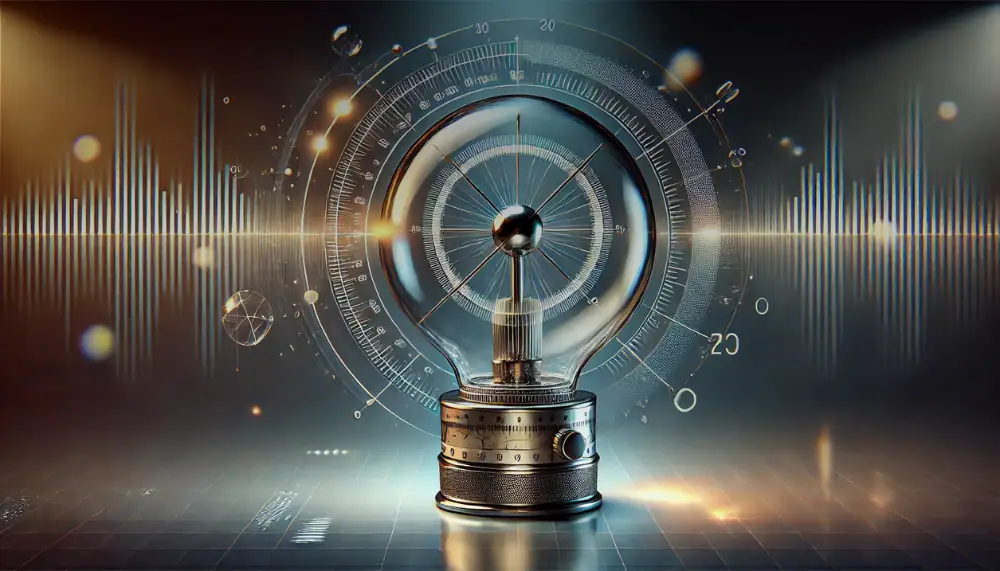
Crookes Radiometer
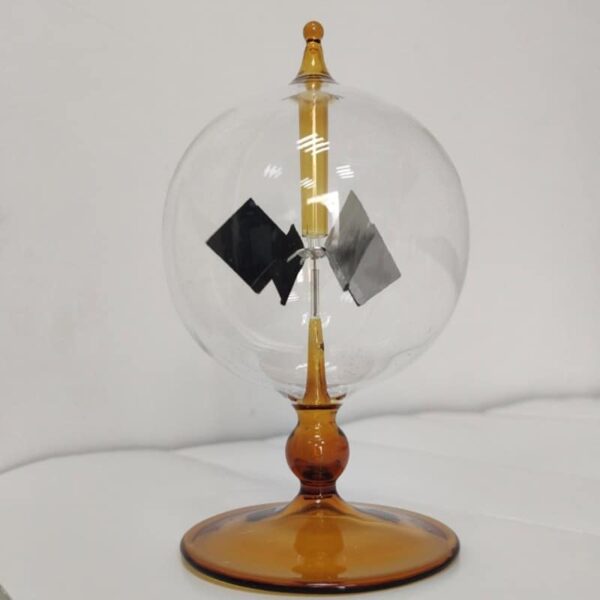
Crookes Radiometer Design
$51.99
Select options
This product has multiple variants. The options may be chosen on the product page
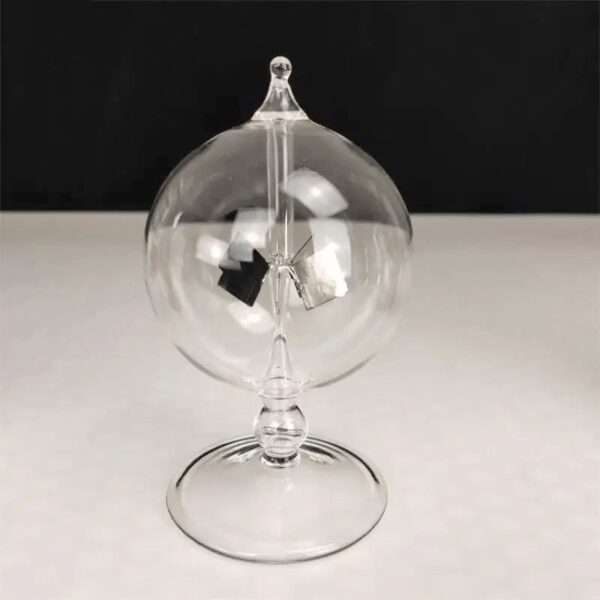
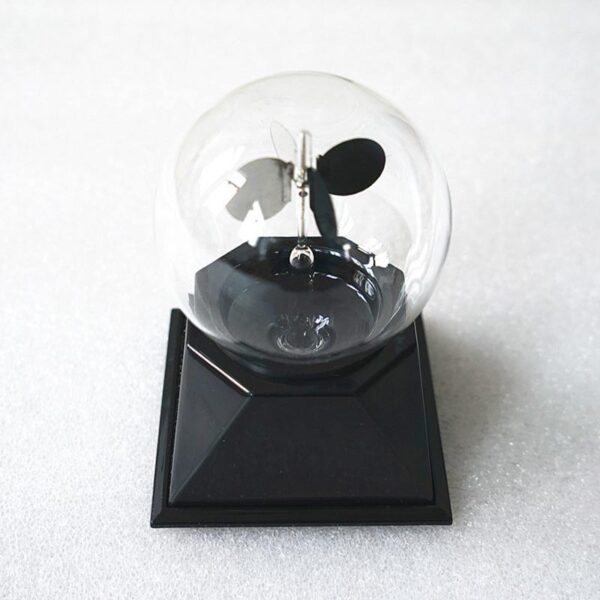
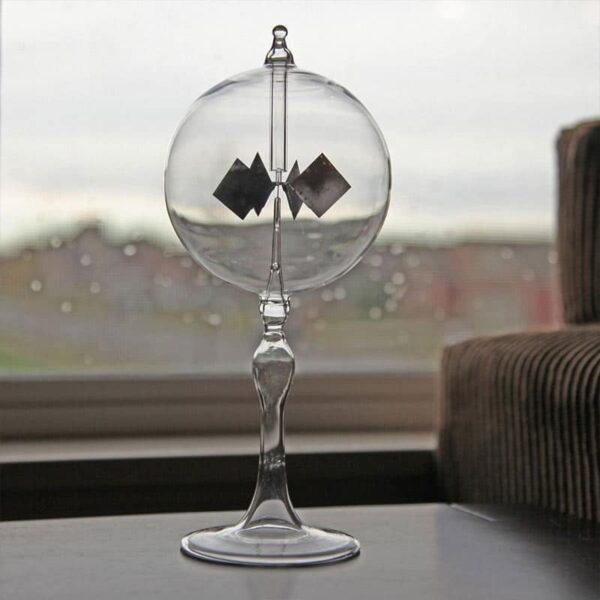
Radiometer (often called a Crookes radiometer) is one of the rare objects capable of making radiation almost “visible.” You place it near a window, under a lamp, or in the sunlight… and its vanes start to spin within their glass bulb. Behind this hypnotic movement, we touch on very concrete concepts: visible light, infrared radiation, absorption, light intensity, and even how the energy carried by photons depends on wavelengths. It’s both a fascinating decorative piece and a great starting point to talk about electromagnetic spectrum without turning the discussion into a lecture.
Crookes Radiometer: a solar object that reacts to light
Why it spins (and what it tells us about light)
The radiometer reacts when it receives a light flow: sunlight or an artificial source. Depending on the illumination, the vanes speed up or slow down. What you observe is the link between irradiation (received energy) and movement, with ideas like absorption and thermal radiation in the background.
And that’s where it gets really interesting: light is not “just one thing.” It covers different wavelengths. The radiometer allows you to ask the right questions: what reacts the most, visible light, the infrared emitted by a warm source, or a cooler light? We are right in the logic of electromagnetic radiation and electromagnetic waves, without having to talk right away about X-rays or gamma rays.
Which radiometer to choose based on your use
There are several styles in this category, and they don’t serve exactly the same purpose:
Glass Crookes Radiometer: the classic model, very readable, perfect if you want to understand the principle and observe it for a long time.
Design Crookes Radiometer: more of a “decorative object,” ideal for a desk, shelf, or reading nook — the kind of piece that grabs the eye even when still.
Solar Radiometer: designed to be placed near a window or in a sunny area, to enjoy solar radiation daily.
Weather Radiometer: excellent if you want to use it as a “visual barometer” of light ambience (overcast sky vs full sun), without claiming to make a precise scientific measurement in lux.
How to use it properly (and achieve a nice movement)
A radiometer works better when you give it light… but not just any way.
1) Place it near a stable light source
Sunlight works very well, especially when it’s direct. A lamp can also work: intensity and distance greatly affect the speed of rotation.
2) Play with the distance
The closer you bring the source, the more the perceived radiation intensity increases. You can literally “see” the effect of the illumination in real-time.
3) Do the visible vs infrared test
Some sources produce more infrared radiation (heat). Others emit mainly in the visible spectrum. It’s a great opportunity to talk about visible spectrum and wavelengths.
Gift idea: 3 profiles who love this
🎁 14-year-old Curious
A glass or solar radiometer: it’s immediate, beautiful, and naturally sparks questions about waves, energy, and light.
🎁 Office “Chic Science” Decor
The design model: it serves as a decorative object, but it comes to life as soon as a ray of sunlight crosses the room.
🎁 Astronomy/Physics Enthusiast
A solar (or weather) radiometer: perfect for connecting sunlight, radiation, and the concept of irradiance in a “living room experiment” mode.
Comparison table: choose quickly
| Model | Look | Best context | What you notice | For whom |
|---|---|---|---|---|
| Glass Radiometer | Classic | Window, lamp, regular use | Readable movement, ideal for discovery | Beginner → curious |
| Design Radiometer | Decor | Office, living room, shelf | “Wow” object + fun science | Gift, decor |
| Solar Radiometer | Bright | Near a sunny window | Responds well to solar radiation | Daily use |
| Weather Radiometer | Original | Bright room, varying skies | Speed changes with illumination | Curious, ambiance |
FAQ
Does the radiometer really measure radiation?
It does not replace a detector or a laboratory instrument. However, it reacts very clearly to light and irradiation: it’s an excellent educational object to understand electromagnetic radiation (visible light + infrared) and the effects of illumination.
Which source works best: sun or lamp?
Solar radiation is often the most spectacular (especially in direct light). A lamp also works: it all depends on its power, distance, and the amount of infrared it emits. You can have fun comparing the results.
Why does it sometimes spin slowly, or not at all?
The radiometer needs a certain level of illumination. If the room is dark, the source is too far away, or the light is too diffuse (very cloudy weather), the rotation may be weak. Bringing the source closer or changing the angle often improves the reaction.
Is it related to wavelengths (infrared / visible)?
Yes, and that’s what’s exciting: depending on the source, the spectral distribution changes. Between visible light and infrared radiation, the received energy and absorption can vary. It’s a very intuitive way to approach wavelengths and the electromagnetic spectrum.
Where should it be placed to be beautiful and “active”?
Near a window (natural light) or in an area where a light beam regularly comes in. On a desk, it becomes a living decorative object, especially when sunlight crosses the room.