Free Shipping on Orders Over $50

Franklin’s Hot Water, also known as Franklin’s Fountain, is a fun physics experiment that demonstrates how air expansion and atmospheric pressure can create a spectacular effect of attracting. and expelling colored water. In short: the water seems to “boil” and spout, while in reality, it is not heating up. Let’s take a detailed look at how it works, its scientific explanation, and its educational applications.
Contenus
afficher
What is Franklin’s Hot Water?
Invented by Benjamin Franklin, famous for his experiments with electricity and fluids, Franklin’s Hot Water is a simple scientific experiment designed to illustrate the laws of pressure and air expansion.
- Device: a glass balloon partially filled with colored water, connected by a tube to a container of water.
- Observation: when gently heating the balloon, the water seems to “boil” and alternately rise like a fountain.
- Objective: to visually show how temperature variation affects air and therefore the surrounding water.

Select options
This product has multiple variants. The options may be chosen on the product page
Franklin’s Boiling Flask
$19.99Principle of Franklin’s Hot Water
The Role of Atmospheric Pressure
The atmospheric pressure exerts a force on every surface. In the experiment, it pushes the water in and out of the balloon depending on air variations. Without this pressure, no water movement would be possible.
Air Expansion
When we heat the air inside the balloon:
- The air expands and pushes out a portion of the water.
- When it cools, it contracts and sucks the water through the tube.
It is this alternation that produces the surprising visual effect.
The “Fountain” Effect
With each cycle, the water is alternately expelled and sucked back, creating the impression of a small boiling fountain. The name “boiling” is misleading: in reality, the water does not reach the boiling point, it is simply the air acting as an invisible piston.
Detailed Scientific Explanation
The experiment relies on the fundamental laws of gases and thermodynamics:
- Heating: the air inside the balloon expands → it pushes the water outward.
- Cooling: the air contracts → the water is sucked into the balloon.
- Cycling: the phenomenon repeats as long as we alternate heating and cooling.
Physical Laws Involved:
- Ideal Gas Law (PV = nRT).
- Principles of thermodynamics.
- Atmospheric pressure as a regulating force.
Note: this is not actual boiling. The confusion arises from the movement of the colored water that mimics boiling.
Conducting Franklin’s Hot Water Experiment
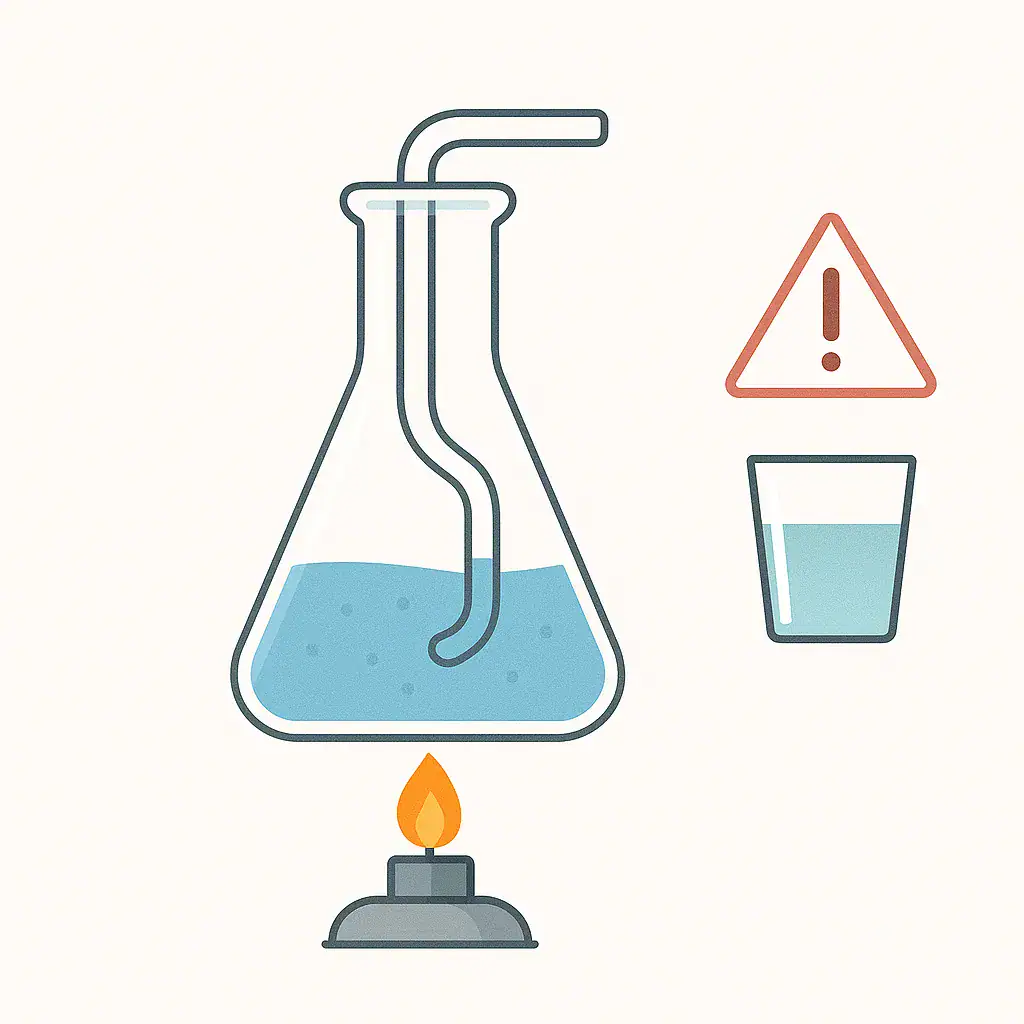
Necessary Materials
- A heat-resistant glass balloon.
- Colored water (to visualize the movement).
- A glass or plastic tube.
- A gentle heat source (candle, low heat plate).
Safety: handle glass carefully, avoid flames too close, and keep the experiment supervised if conducted with children.
Steps to Perform
- Partially fill the balloon with colored water.
- Position the tube to connect the balloon to the water container.
- Gently heat the balloon → observe the expulsion of water.
- Let it cool → observe the sucking of water.
For better observation, use colored water to make the phenomenon visually more spectacular.
Educational Applications
Franklin’s Hot Water is a powerful educational tool:
- In class: illustrate gas expansion and atmospheric pressure.
- In popularization: make complex physical laws accessible.
- With children: awaken scientific curiosity through a visual and fun experiment.
| Aspect | What You Observe | Scientific Explanation |
|---|---|---|
| Water expulsion | Water shoots out of the balloon | Air expansion forces the liquid out |
| Water suction | Water rises back into the balloon | Air contraction creates a vacuum |
| Repeated cycle | Fountain effect | Alternation between pressure and vacuum |
Other Related Experiments
Franklin’s Hot Water is not isolated: it is part of a long tradition of fun physics experiments:
- The Diving Duck: also based on air pressure and volume variations.
- The Magdeburg Hemispheres: demonstration of the power of atmospheric pressure.
- Other Franklin experiments: including his famous work on electricity with the kite and the lightning.
Quick FAQ
Is it dangerous?
No, if the experiment is supervised and conducted with gentle heating. The main risk comes from heated glass.
Why is it called “boiling”?
Because the colored water mimics boiling through its movement, but there is no real boiling.
Can it be done at home?
Yes, with the right materials and precautions. It is an ideal experiment for understanding science as a family.
Conclusion
Franklin’s Hot Water is a simple yet fascinating experiment that combines atmospheric pressure and gas expansion to create an impressive visual effect. It perfectly illustrates the beauty of accessible physics and remains an essential educational tool to spark the curiosity of both young learners and science enthusiasts, just like the Stirling engine or the Newton’s pendulum.