Free Shipping on Orders Over $50


You have probably seen a watch with a futuristic design featuring column LEDs and wondered: how do you read the time on that? Binary watches display the time in base 2. Good news: with 2-3 visual cues and a bit of practice, reading it becomes very simple.
Contenus
afficher
What is a binary watch?
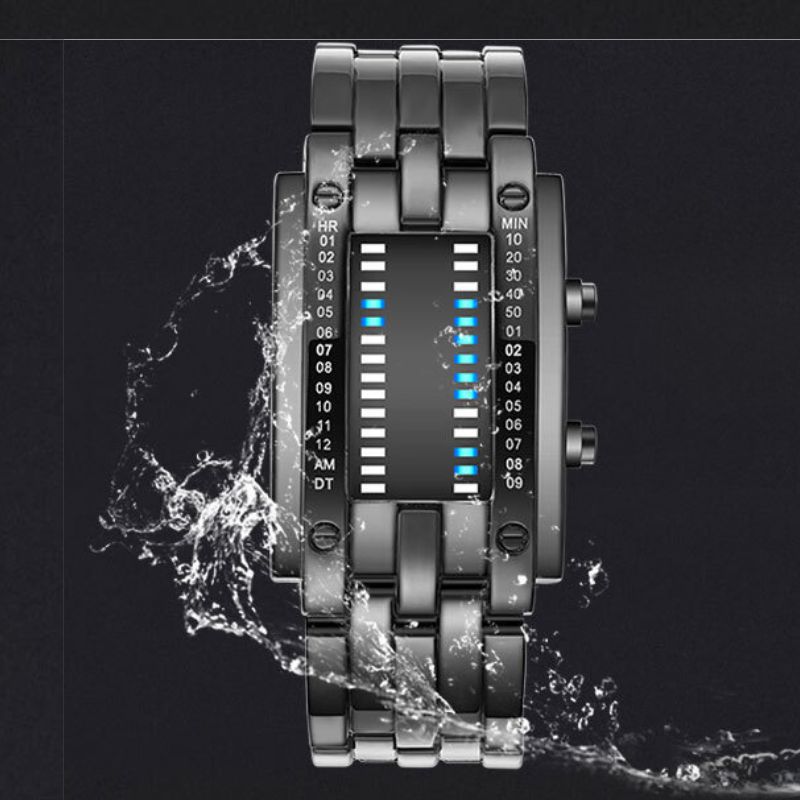
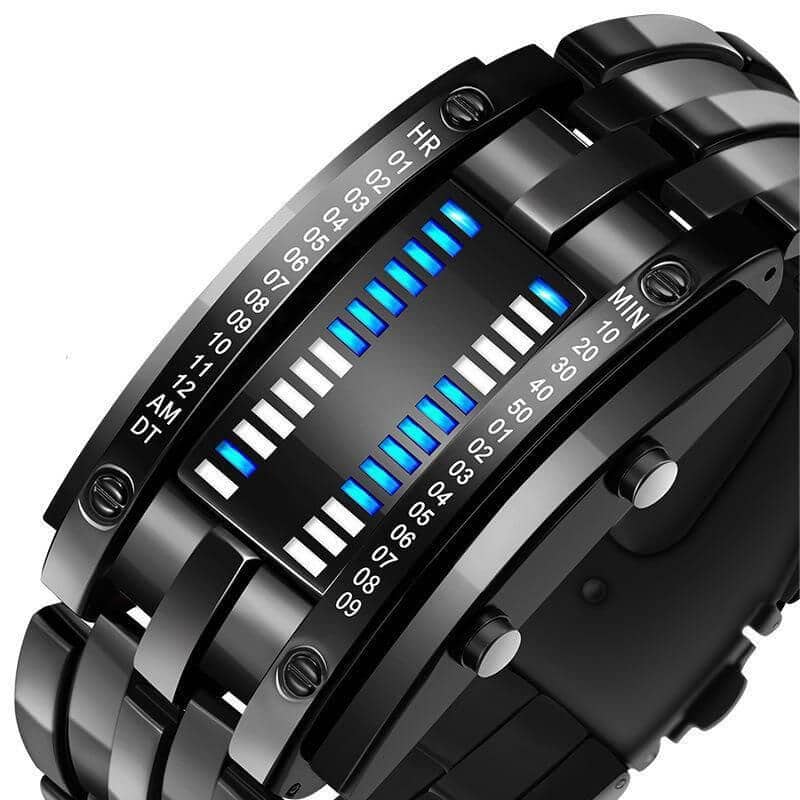
A binary watch uses LEDs on/off to represent numbers in base 2: on LED = 1, off LED = 0. The display is generally organized into columns: one for hours, one for minutes (sometimes a third for seconds).
Understanding the binary system (quick reminder)
In decimal, we count in powers of 10 (1, 10, 100…). In binary, we count in powers of 2: 1, 2, 4, 8, 16, 32, etc. Each LED corresponds to one of these values. We add the values of the lit LEDs to get the number.
Power memo table (from bottom to top)
| LED Position | Binary Value | Decimal Value |
|---|---|---|
| 1 (bottom) | 2⁰ | 1 |
| 2 | 2¹ | 2 |
| 3 | 2² | 4 |
| 4 | 2³ | 8 |
| 5 | 2⁴ | 16 |
| 6 (top) | 2⁵ | 32 |
Typical structure of a binary watch
Columns and markers
- Left column: hours
- Right column: minutes
- Sometimes: a 3rd column for seconds
Depending on the models, the LEDs can be vertical (most common) or horizontal. The reading principle remains the same.
Reading the time step by step
Step 1: identify the columns
Identify which column corresponds to hours and which column corresponds to minutes. This is often indicated on the dial; if not, check the manual.
Step 2: note the lit LEDs
For each column, note the lit LEDs and their values (1, 2, 4, 8, 16, 32). Tip: memorize the order of powers of 2 to go faster.
Step 3: add them up
Add the lit values: the total = the displayed hour (or minutes).
Concrete examples
- Hours: LED 4 + LED 1 lit → 4 + 1 = 5 h
- Minutes: LED 32 + LED 8 + LED 2 lit → 32 + 8 + 2 = 42 min
- Displayed result: 5h42
Select options
This product has multiple variants. The options may be chosen on the product page
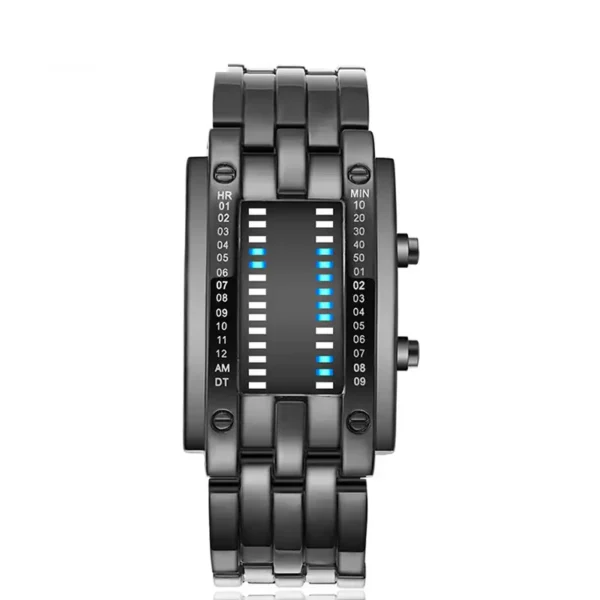
Binary Watch
$34.99Advantages & limitations
Why we love it
- Unique design & guaranteed conversation starter
- Fun little intellectual challenge every day
- Perfect for fans of tech/science
Things to know before buying
- Requires a short learning curve
- Reading is a bit less instantaneous than a traditional watch
Tips for learning faster
- Routine: read the time in binary 3–4 times/day for a week
- Visual memo: associate each position with its value (1–2–4–8–16–32)
- Hybrid: some models display binary + digital to confirm at a glance
Variants and models
- Pure binary LEDs: only LEDs
- Hybrids: binary + digital display
- Apps & widgets: practice on your smartphone before buying
Conclusion
Reading a binary watch is simple and fun once you know the powers of 2 and how to add the lit LEDs. Beyond its utility, it’s a style accessory that showcases your taste for innovation and tech culture.
FAQ
How long to learn?
A few days of practice are enough for fluid reading.
Are seconds displayed?
Sometimes yes, via a third column. Otherwise, just hours + minutes.
Practical for daily use?
Yes, especially after the learning phase. Many adopt it for its originality.
Feel free to check out our other scientific watches.